







Imagine this: you ask Alexa to play your favorite song, and within seconds she says, “Playing Tum Se Hi by Mohit Chauhan.”
Magic? Nope, that’s Artificial Intelligence.
Now when Netflix recommends the next movie, you’ll probably binge-watch till 2 AM. That's Machine Learning quietly doing its job.–
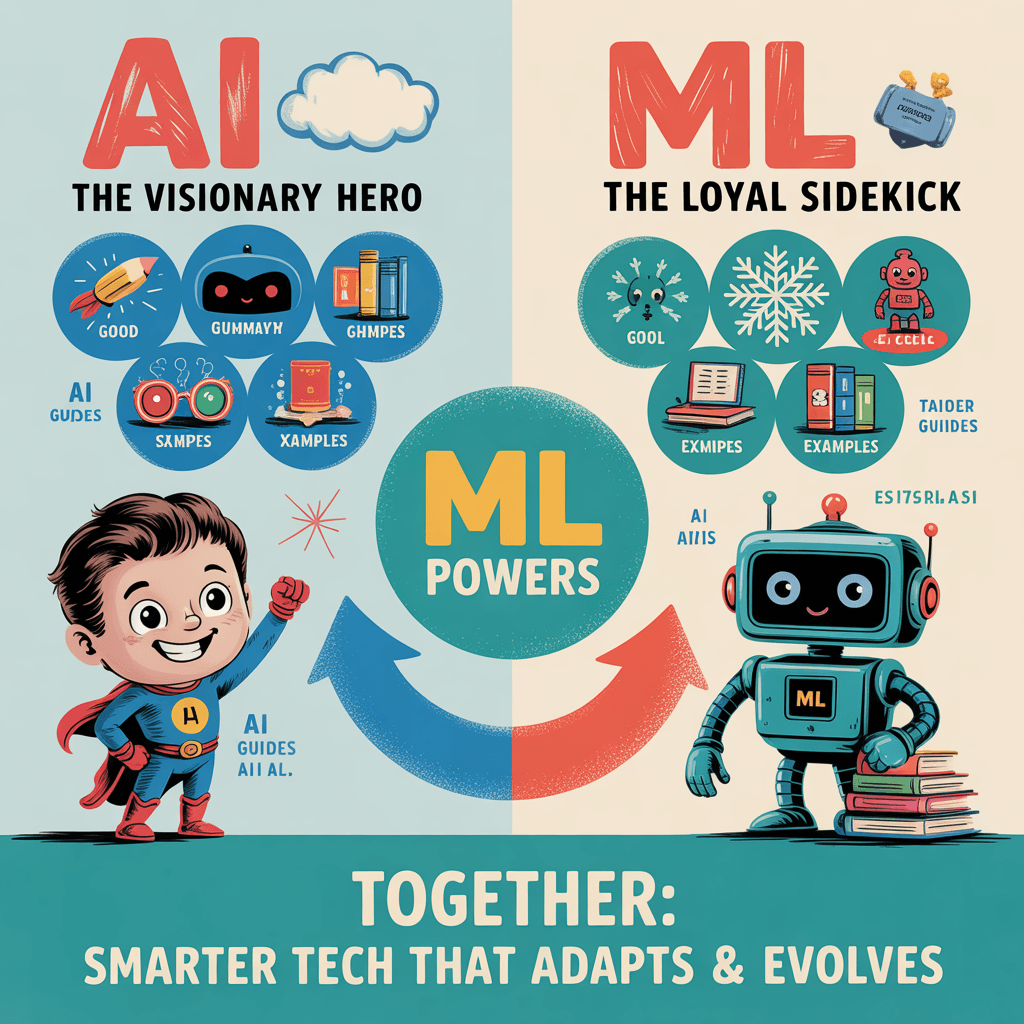
Both sound super similar, right? But here’s the twist: AI and ML are like siblings with different talents. One dreams big like Iron Man (AI), and the other learns from experience like Spider-Man (ML).
Summary
Artificial Intelligence and Machine Learning are like the Batman and Robin of the tech world inseparable, powerful, but with their own superpowers.
AI is the big dreamer. It wants machines to think, talk, reason, and act like us. It’s the brain behind self-driving cars, smart assistants, and even robots that can play chess better than humans.
Machine Learning, on the other hand, is the hardworking learner. It doesn't try to act smart right away; it studies tons of data, learns from experience, and then makes predictions that feel almost magical.
If AI is like teaching a robot to think, ML is like teaching it to learn on its own.
AI = The brain that makes decisions
ML = The student that learns from experience
Together, they make our world smarter one voice command, one recommendation, and one prediction at a time!

Content Table
Section | Description / What to Cover |
1. Introduction | Hook your reader: Start with a relatable example or fun analogy about AI and ML. Briefly explain why the distinction matters. |
2. What is AI? | Define Artificial Intelligence in simple terms. Mention types: Narrow AI, General AI. Include examples like Siri, self-driving cars. |
3. What is Machine Learning? | Explain ML as a subset of AI. Show how machines “learn from data.” Mention types: Supervised, Unsupervised, Reinforcement Learning. |
4. AI vs ML: Key Differences | Use a table or bullet points to highlight differences: scope, purpose, examples, data dependency, learning ability. |
5. Real-World Examples | Make it engaging: AI in healthcare, ML in recommendation systems, AI in smart homes, ML in fraud detection. |
6. How They Work Together | Explain how ML powers AI systems. Simple diagrams or analogies (like ML is the brain, AI is the body). |
7. Common Misconceptions | Address myths: “AI = ML?”, “AI will replace humans,” etc. Keep it light and witty. |
8. Future Trends | Talk about emerging AI/ML tech: Generative AI, autonomous robots, AI ethics. Keep it exciting and forward-looking.
|
9. Conclusion | Summarize key points. Reinforce the difference and complementarity of AI and ML. End with a thought-provoking line. |
Introduction: “When Machines Start Thinking”
Imagine walking into a room and your phone immediately knows what song you want to play, your car stops itself just in time to avoid a jaywalker, and your online shopping app recommends the perfect outfit before you even think about it. Sounds like magic? Well, it’s not. This is the world of Artificial Intelligence (AI) and Machine Learning (ML), the dynamic duo behind the smart tech that’s quietly running our lives.
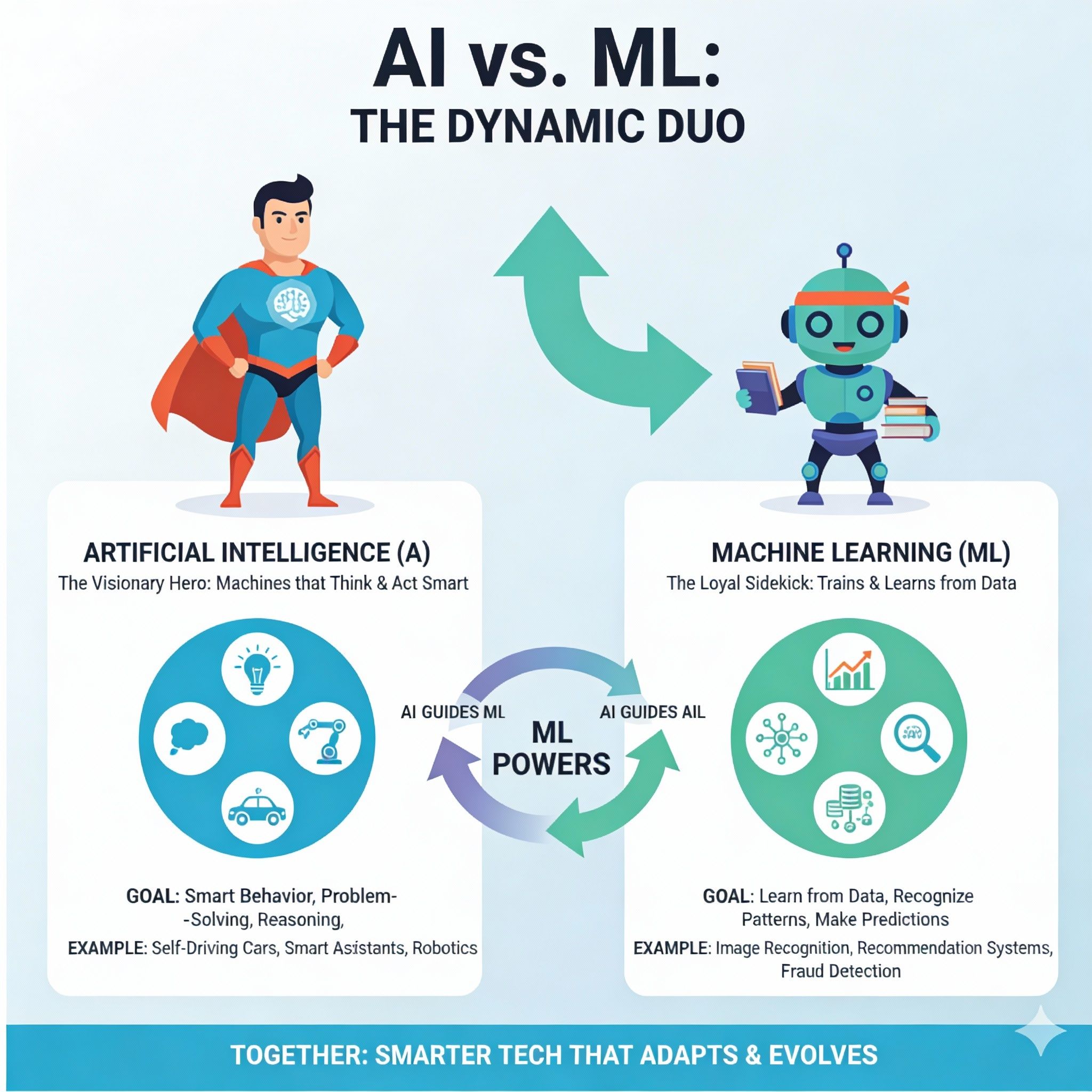
But here’s the catch: while people often use AI and ML interchangeably, they’re not the same. Think of AI as the superhero with endless potential, and ML as the trusty sidekick that trains, learns, and levels up the superhero’s skills. In this article, we’ll dive into the difference between AI and ML, explore real-world examples, and even bust some common myths all without making your brain hurt.
What is AI? The Brain Behind Smart Machines
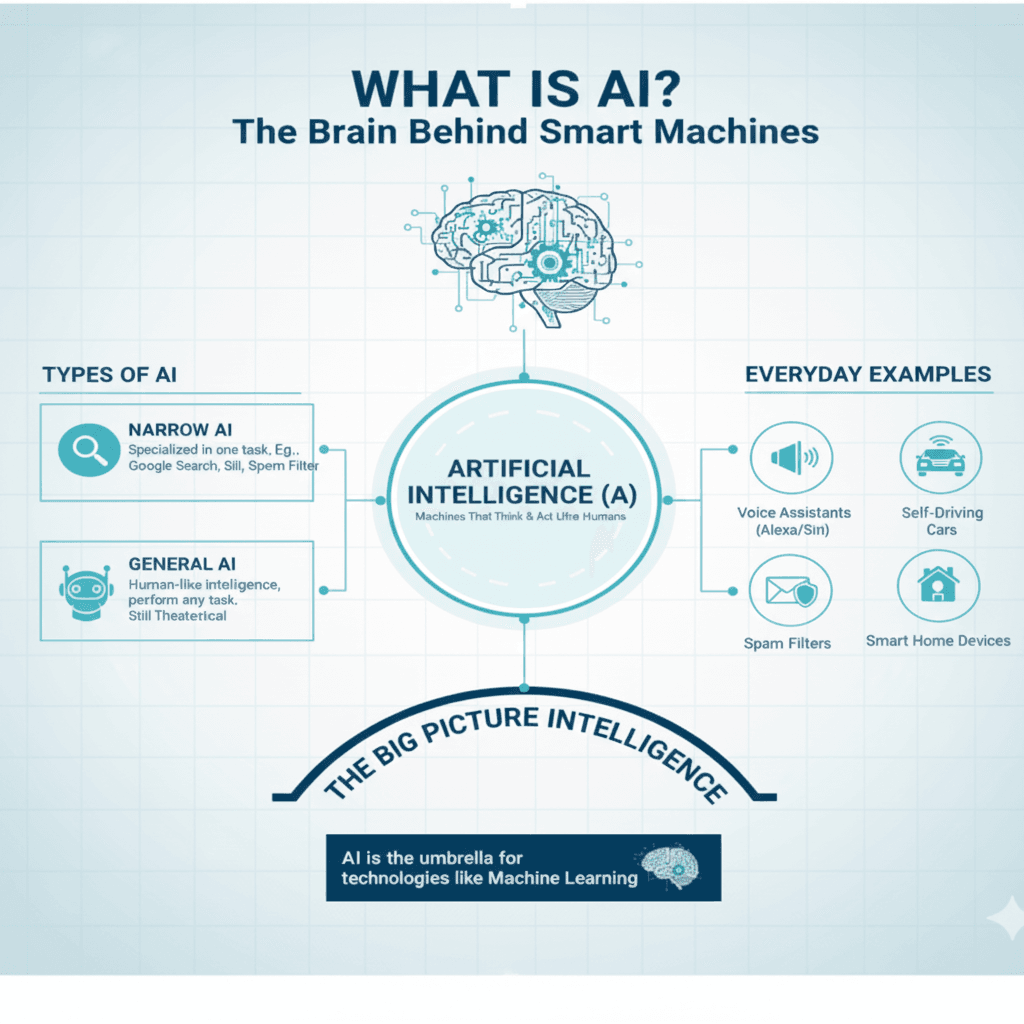
Artificial Intelligence, or AI, is like giving machines a “brain” to think, learn, and make decisions almost like a human, but faster and tireless. It’s not about robots taking over the world (Hollywood lied); it’s about machines solving problems in ways that used to require human intelligence.
Key points to highlight:
Definition: AI is the simulation of human intelligence in machines that are programmed to think and act like humans.
Types of AI:
Narrow AI: AI specialized in one task (e.g., Google Search, Siri).
General AI: A more advanced, human-like intelligence that can perform any task still mostly theoretical.
Everyday Examples:
- Voice assistants like Alexa or Siri
- Self-driving cars
- Spam filters in your email
- Smart home devices that learn your habits
AI is essentially the umbrella under which technologies like Machine Learning thrive. It’s the “big picture” intelligence that powers the devices and apps we use daily.
What is Machine Learning? The Secret Sauce of Smart Machines
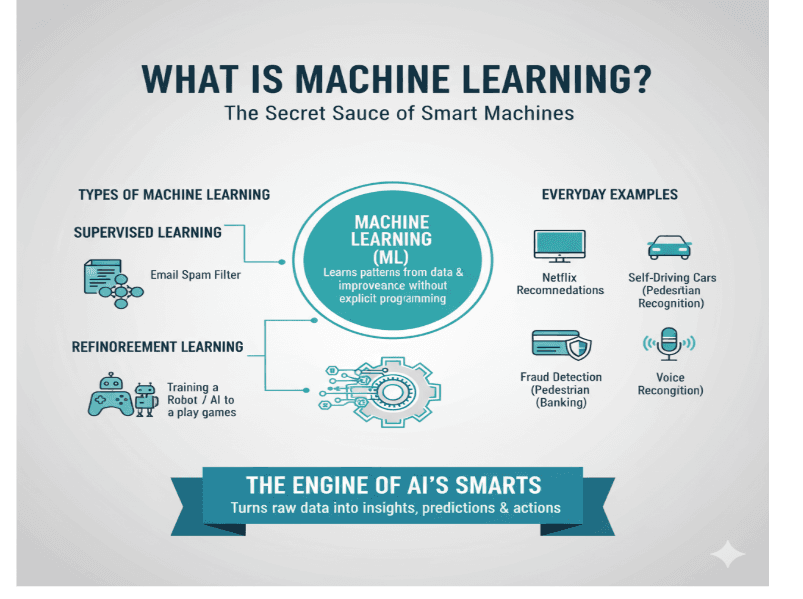
If AI is the brain, Machine Learning (ML) is the part that learns from experience. Instead of programming every single instruction, ML lets machines figure things out from data, just like humans learn from trial and error.
Key points to highlight:
Definition: ML is a subset of AI that enables machines to learn patterns from data and improve their performance over time without being explicitly programmed.
Types of Machine Learning:
- Supervised Learning: Learning with labeled data (e.g., teaching an email filter what’s spam).
- Unsupervised Learning: Learning patterns from unlabeled data (e.g., grouping customers by buying behavior).
- Reinforcement Learning: Learning by trial and error with feedback (e.g., training a robot to walk or an AI to play games).
Everyday Examples:
Netflix recommending your next binge-worthy show
Self-driving cars recognizing pedestrians
Fraud detection in banking transactions
Voice recognition in your phone
In short, ML is the engine that powers AI’s smarts, turning raw data into insights, predictions, and actions without constant human guidance.
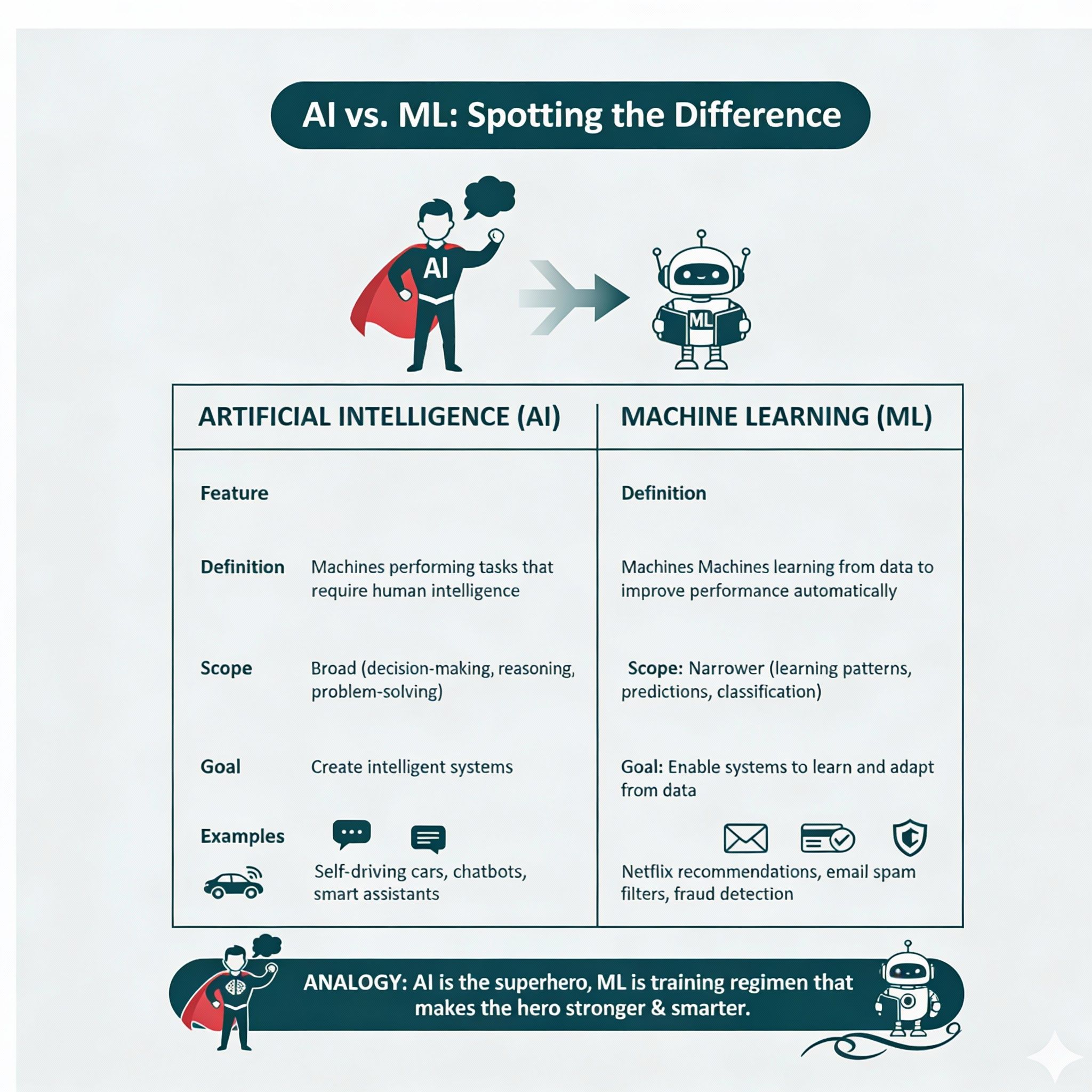
AI vs ML: Spotting the Difference
People often mix up AI and ML, but here’s the simple way to remember:
AI is the big picture intelligence: the goal of making machines smart.
ML is how that intelligence actually learns: the method behind the magic.
Feature | Artificial Intelligence (AI) | Machine Learning (ML) |
Definition | Machines performing tasks that require human intelligence | Machines learning from data to improve performance automatically |
Scope | Broad (decision-making, reasoning, problem-solving) | Narrower (learning patterns, predictions, classification) |
Goal | Create intelligent systems | Enable systems to learn and adapt from data |
Examples | Self-driving cars, chatbots, smart assistants | Netflix recommendations, email spam filters, fraud detection |
Human Intervention | Often requires programming and rules | Learns automatically from data with minimal explicit programming |
Output | Decisions or actions | Predictions or insights |
Analogy: Think of AI as a superhero, and ML as the training regimen that helps the superhero get stronger and smarter every day.
Real-World Examples: Where AI and ML Shine
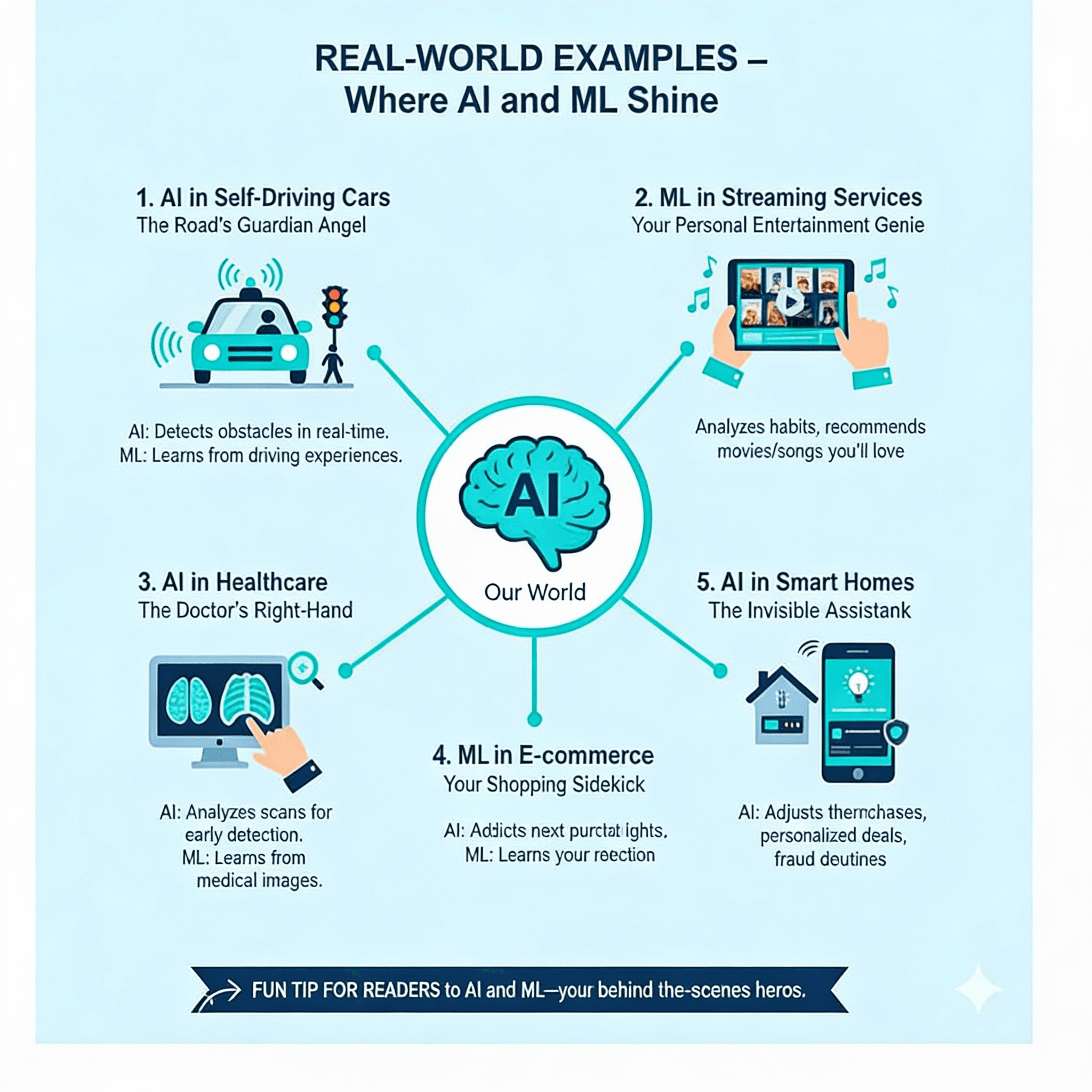
AI and ML aren’t just tech buzzwords they’re quietly running our world in ways you probably use every day:
1. AI in Self-Driving Cars: The Road’s Guardian Angel
AI helps cars detect traffic lights, pedestrians, and obstacles in real-time. ML helps the car learn from driving experiences, improving safety with every mile.
2. ML in Streaming Services: Your Personal Entertainment Genie
Platforms like Netflix or Spotify use ML to analyze your viewing/listening habits and recommend movies, shows, or songs you’ll love sometimes even before you know you want them.
3. AI in Healthcare: The Doctor’s Right-Hand
AI-powered tools analyze X-rays and MRI scans to spot diseases early. ML algorithms learn from thousands of medical images, helping doctors detect tumors, fractures, or anomalies faster and more accurately.
4. ML in E-commerce: Your Shopping Sidekick
Online stores use ML to predict what you might buy next, show personalized deals, or detect fraudulent transactions. That “Recommended for You” section? That’s ML at work.
5. AI in Smart Homes: The Invisible Assistant
From adjusting your thermostat to turning on lights when you enter a room, AI helps your home think ahead. ML lets it learn your routines, making life smoother and smarter.
Fun Tip for Readers:
The next time your phone autocorrects your typing perfectly, or your car brakes automatically in time, give a silent nod to AI and ML, your behind-the-scenes heroes.
How AI and ML Work Together: The Dynamic Duo
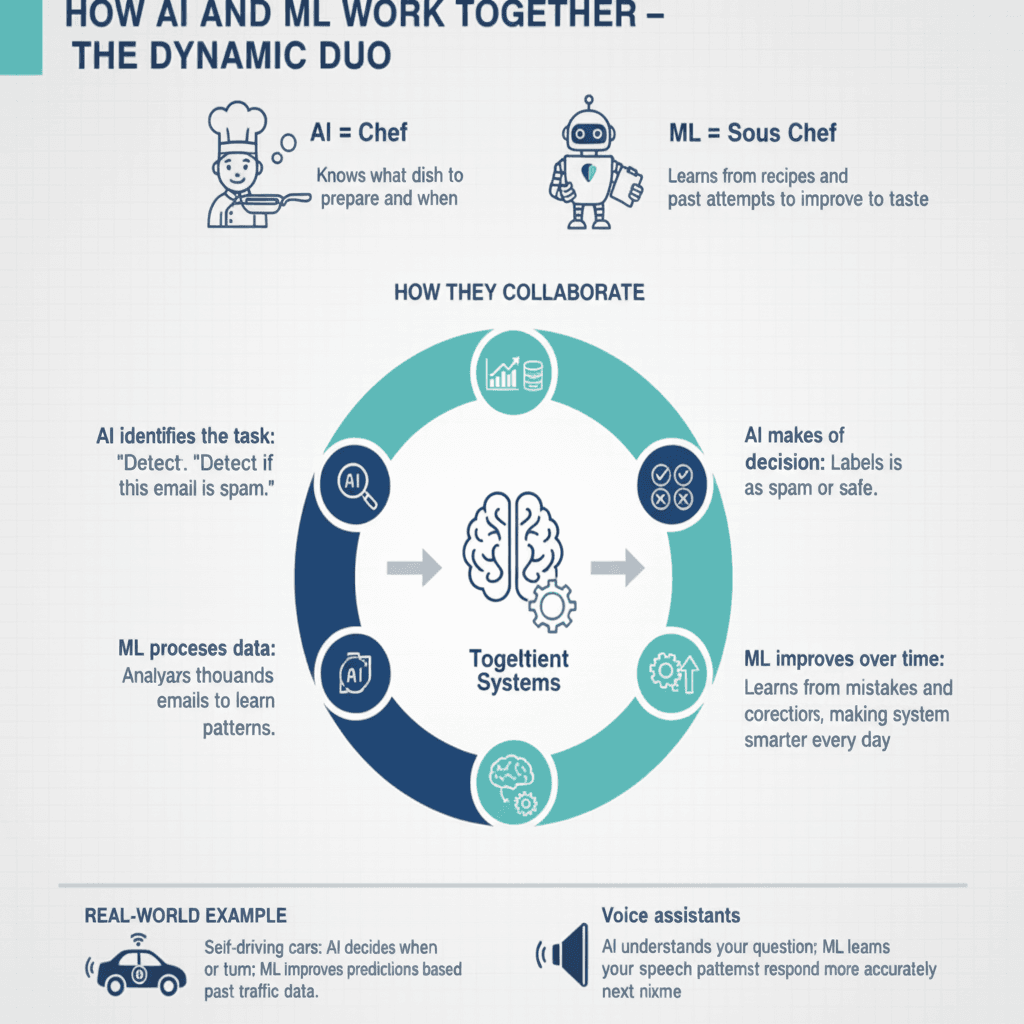
Think of AI as the brain and ML as the muscle. AI decides what needs to be done, while ML figures out how to do it better over time by learning from data. Together, they create intelligent systems that can see, understand, predict, and act almost like having a superhero team with a master plan.
Simple Analogy:
AI = Chef → knows what dish to prepare and when
ML = Sous Chef → learns from recipes and past attempts to improve the taste
How They Collaborate:
AI identifies the task: For example, “Detect if this email is spam.”
ML processes data: Analyzes thousands of emails to learn patterns.
AI makes a decision: Labels the email as spam or safe.
ML improves over time: Learns from mistakes and user corrections, making the system smarter every day.
Real-World Example:
Self-driving cars: AI decides when to brake or turn; ML improves predictions based on past traffic data.
Voice assistants: AI understands your question; ML learns your speech patterns to respond more accurately next time.
Takeaway: AI sets the goal, ML teaches the system how to achieve it. Together, they make machines truly smart.
Common Misconceptions: Busting AI & ML Myths
AI and ML are fascinating, but they’ve also attracted a lot of confusion and Hollywood-style myths. Let’s clear the air:
Myth 1: AI = ML
Reality: ML is just a subset of AI. AI is the big picture (making machines intelligent), ML is one way AI learns from data.
Myth 2: AI will replace all humans
Reality: AI automates tasks, but human creativity, empathy, and judgment are irreplaceable. Think of AI as a helper, not a replacement.
Myth 3: AI is conscious
Reality: AI doesn’t have feelings, thoughts, or awareness it only follows algorithms and data patterns.
Myth 4: ML is perfect after training
Reality: ML is only as good as its data. Biased or limited data can lead to mistakes. It’s learning, not magic.
Myth 5: AI is only for tech experts
Reality: AI-powered tools are already in everyday life: your phone, email, shopping apps, and even smart appliances use AI and ML.
Fun Tip: Next time someone says, “AI is going to take over the world,” smile and say: “Not yet it’s still learning!”
Future Trends: What’s Next for AI & ML
AI and ML aren’t just shaping today, they're rewriting the future. Here’s what’s coming next:
1. Generative AI: Creativity Meets Machines
AI that can write stories, compose music, and even generate art. Think of it as a creative partner that can brainstorm with you.
2. Autonomous Vehicles: Smarter Roads Ahead
Self-driving cars and drones will become safer and more efficient as AI and ML learn from massive amounts of traffic and sensor data.
3. AI in Healthcare: Smarter, Faster Diagnoses
AI tools will predict diseases before symptoms appear, personalize treatments, and assist doctors with complex decisions.
4. AI Ethics & Responsible AI
As AI grows, so does the need for ethical use avoiding bias, protecting privacy, and ensuring AI decisions are fair and transparent.
5. AI-Powered Robotics: Smarter Machines, Better Lives
From household robots to industrial automation, AI and ML will make machines more adaptive, intelligent, and collaborative with humans.
6. Edge AI: Intelligence Everywhere
AI won’t just live in the cloud it will be on your phone, camera, or IoT device, making real-time decisions faster and smarter.
Takeaway: The future of AI & ML is limitless, blending convenience, creativity, and intelligence while challenging us to think ethically and responsibly.
Conclusion: The AI & ML Journey
AI and Machine Learning aren’t just tech jargon, they're the invisible forces shaping our daily lives. AI is the grand vision, the brain behind smart systems, while ML is the learning engine that teaches those systems to get better over time.
From self-driving cars to personalized streaming, healthcare innovations to smart homes, AI and ML are transforming how we live, work, and play.
The exciting part? We’re just scratching the surface. The future promises smarter machines, more creative tools, and a world where AI and ML collaborate seamlessly with humans not replace us.
So next time your phone autocorrects perfectly or a car brakes just in time, remember: it’s AI dreaming big, and ML doing the homework.
Additional Readings:
If you’re fascinated by AI, Machine Learning, and the future of technology, AlmaBetter is your go-to learning hub! From beginner-friendly tutorials to real-world case studies, AlmaBetter makes complex concepts fun, practical, and easy to understand.
Check out these hand-picked resources to dive deeper, explore real-world applications, and supercharge your AI & ML knowledge:
Exploring the Major Domains of AI
Want to see how AI isn’t just about robots? Explore the different domains where AI is changing the game from natural language processing to computer vision.
Link:https://www.almabetter.com/bytes/articles/domains-of-ai?utm_source=chatgpt.com
Introduction to Artificial Intelligence
Curious about AI basics? This beginner-friendly guide breaks down AI concepts in simple terms and real-world examples.
Link:https://www.almabetter.com/bytes/tutorials/artificial-intelligence/introduction-to-artificial-intelligence?utm_source=chatgpt.com
Top 10 Machine Learning Algorithms for Beginners
Learn the building blocks of ML! Discover the most popular algorithms and how they power everyday applications like recommendations and fraud detection.
Link:https://www.almabetter.com/bytes/articles/top-machine-learning-algorithms?utm_source=chatgpt.com
Machine Learning Case Study in Healthcare
See ML in action! Explore a real-world case study showing how ML is transforming patient care and diagnostics in hospitals.
Link:https://www.almabetter.com/bytes/articles/machine-learning-case-study-in-health-care-industry?utm_source=chatgpt.com
Top 10 Applications of Artificial Intelligence in 2025
From smart cars to virtual assistants, check out the coolest AI applications that are shaping our lives today.
Link: https://www.almabetter.com/bytes/articles/applications-of-artificial-intelligence?utm_source=chatgpt.com
Top 6 Best Applications of Machine Learning in the Real World
Get inspired by innovative ML applications across industries from finance to entertainment and see how learning from data is changing the world.
Link: https://www.almabetter.com/bytes/articles/machine-learning-success-stories-inspiring-innovations-and-breakthroughs?utm_source=chatgpt.com
Mastering Deep Learning Algorithms
Want to go beyond ML? Discover deep learning, the technology powering self-driving cars, image recognition, and voice assistants.
Link:https://www.almabetter.com/bytes/articles/deep-learning-algorithms?utm_source=chatgpt.com
Forward and Backward Reasoning in AI
Learn how AI systems “think” using reasoning techniques to make decisions, solve problems, and simulate human-like intelligence.
Link:https://www.almabetter.com/bytes/tutorials/artificial-intelligence/forward-and-backward-reasoning-in-ai?utm_source=chatgpt.com
Normalization in Machine Learning
Understand a key ML technique that prepares your data for smarter predictions, faster learning, and better model performance.
Link:https://www.almabetter.com/bytes/tutorials/data-science/normalization-in-machine-learning?utm_source=chatgpt.com







 in Bengaluru, India


 in Bengaluru, India