







When Priya started working at a hospital’s research lab, her first task seemed oddly simple: teach a computer to tell whether an X-ray showed a healthy lung or a diseased one. The computer, however, knew nothing. To it, every image was just a blur of pixels, no sickness, no health, just data.
So Priya began feeding it thousands of X-rays, each carefully labeled by doctors as “normal” or “infected.” Slowly, the computer started recognizing patterns — the cloudy spots, the dark shadows, the subtle differences invisible to the untrained eye. Weeks later, when given a new image it had never seen before, the computer guessed the right diagnosis almost like a student who had finally learned his lesson.
That was Priya’s first encounter with supervised learning, a powerful branch of artificial intelligence where machines learn from labeled examples, just the way we humans learn with guidance and feedback.
Summary
Imagine teaching a child to recognize fruits. You show them an apple and say, “This is an apple.” Show enough examples, and soon the child can spot one on their own. That’s exactly how machines learn through supervised learning, one of the most fascinating branches of artificial intelligence.
In this article, readers will uncover how computers learn from labeled examples of data that already carries the right answers to make accurate predictions in the real world. From identifying faces in photos to filtering spam, predicting house prices, and even diagnosing diseases, supervised learning quietly powers much of our daily digital life.
You’ll explore the two main types of classification (deciding “which type?”) and regression (predicting “how much?”) and meet the core algorithms like Decision Trees, KNN, and XGBoost, each playing the role of a different “teacher.”
The article also reveals supervised learning’s strengths and limits its brilliance with clean, labeled data and its struggle with the unexpected while showing how this technology transforms data into decisions. By the end, readers will see how the “magic” of supervised learning shapes the smart systems around us and how they, too, can learn to harness its power in the growing world of AI
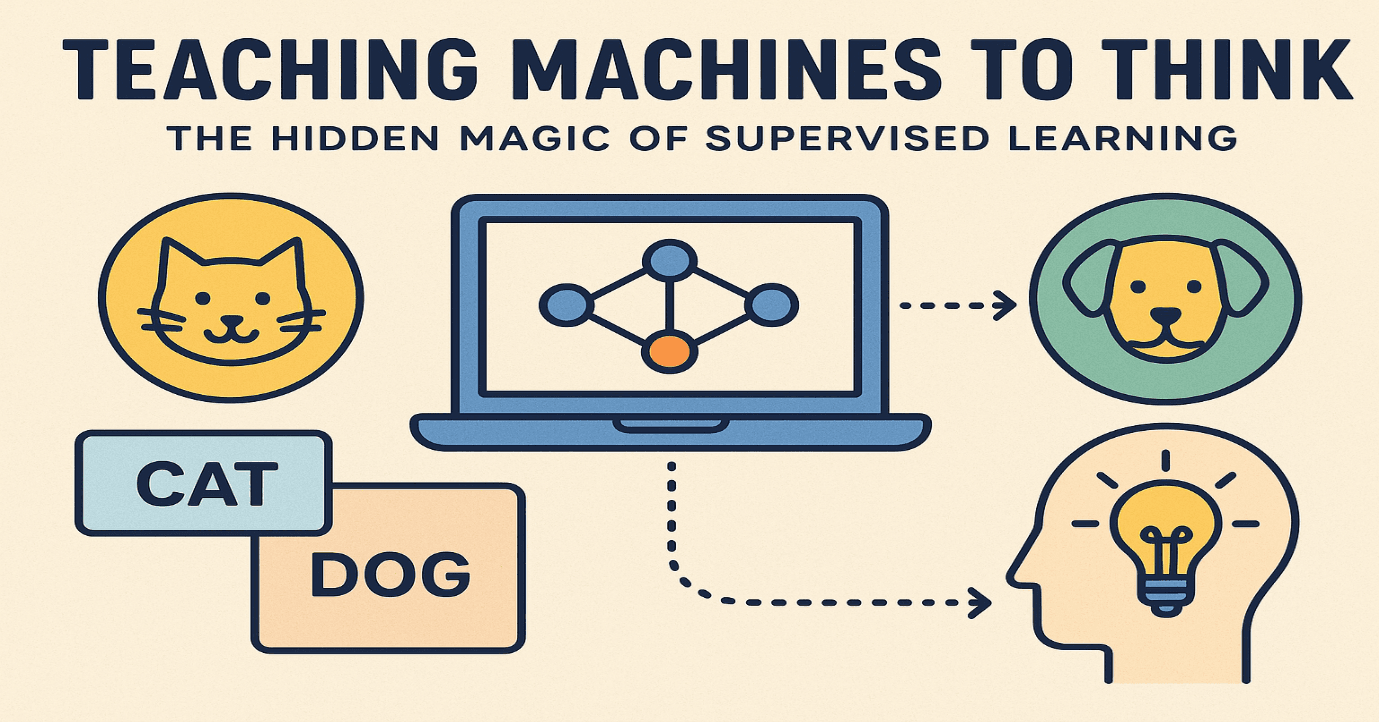
Outline of Topics Covered in This Article
| Sr. No. | Section Title | Subsections |
|---|---|---|
| 1 | How Machines Learn Like Humans: The Magic of Supervised Learning | — |
| 2 | What is Supervised Learning? | — |
| 3 | The Two Flavors of Supervised Learning | Classification, Regression |
| 4 | The “Teachers” Behind Supervised Learning Algorithms | Linear Regression, Logistic Regression, KNN, SVM, Naive Bayes, Decision Tree, Random Forest, Gradient Boosting, XGBoost |
| 5 | Where Supervised Learning Powers Our World | — |
| 6 | Why Supervised Learning Rocks… and Its Limits | — |
| 7 | The Magic Behind Smart Machines | — |
The Magic of Supervised Learning
How does an AI know whether an image shows a cat or a dog, or if an email is spam or not?
Through supervised learning, AI is trained on thousands of labelled examples that teach it to recognize patterns and make accurate predictions.
What is Supervised Learning?
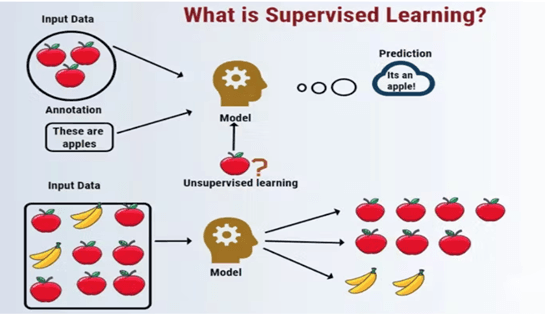
Supervised learning is a type of machine learning where computers are trained using labelled data. Just like a student learns from examples and feedback, a computer learns from input-output pairs. By analysing patterns in these examples, the system can predict outcomes for new, unseen data. This approach is widely used in tasks like image recognition, spam detection, language translation, and more.
Imagine teaching a child to recognize fruits. You show them a picture of an apple and say, “This is an apple.” Then you show a banana and say, “This is a banana.” After seeing enough examples, the child can confidently point out an apple or a banana in a new picture they’ve never seen before.
Supervised learning works in the same way, except instead of a child, it’s a computer, and instead of flashcards, it gets thousands of labelled examples. The computer studies the patterns in the data, the shapes, colours, or other features and learns to predict the correct label for new, unseen data.
Whether it’s deciding if an email is spam or detecting whether a photo contains a dog or a cat, supervised learning is all about learning from examples and getting better with practice. In essence, the algorithm becomes smarter with every example it sees, just like a student learning from exercises and feedback.
The Two Flavors of Supervised Learning:
Think of supervised learning like teaching a curious friend depending on what you want them to learn; you take a different approach.
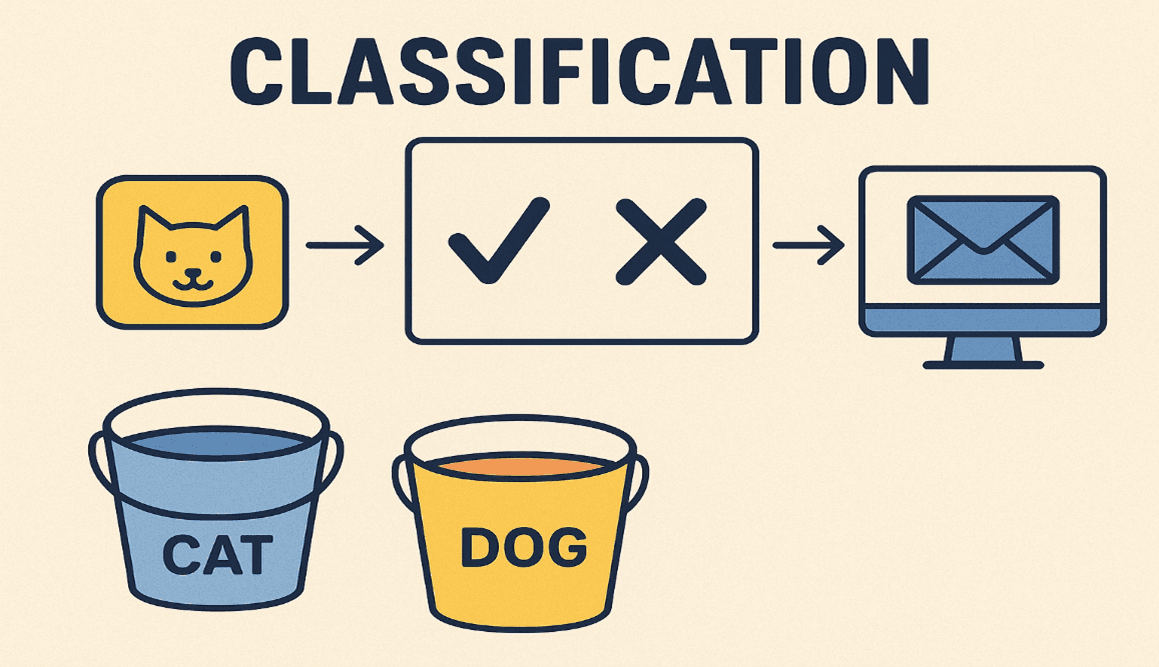
Classification: This is like sorting things into buckets. Is it a cat or a dog? Spam or not spam? The computer looks at examples and learns to put new things in the right category.
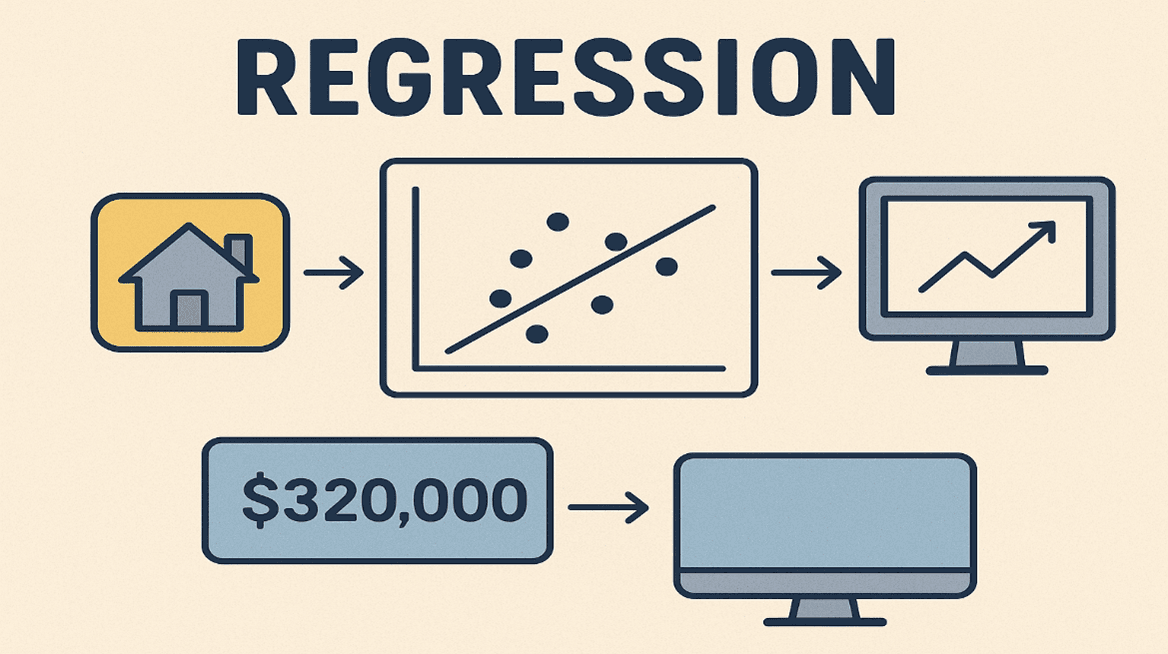
Regression: This is about predicting numbers. How much will that house sell for? What will the temperature be tomorrow? Here, the computer estimates values based on patterns it has seen.
In short, classification answers “which type?”, and regression answers “how much?” and together, they form the backbone of supervised learning in the real world.
The “Teachers” Behind Supervised Learning Algorithms
Once we know what we want the computer to do, we need the right tools to teach it. These tools are called algorithms. Think of them as clever “teachers” that guide the machine to learn from examples.
Here are some popular ones:
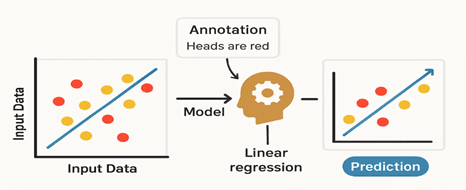
Linear Regression
- Think of it like drawing the best straight line through a scatter plot of dots.
- It tries to predict numbers (like house prices) based on relationships (like size vs. price).
- If the pattern is straight-ish, it's your go-to tool.
Logistic Regression
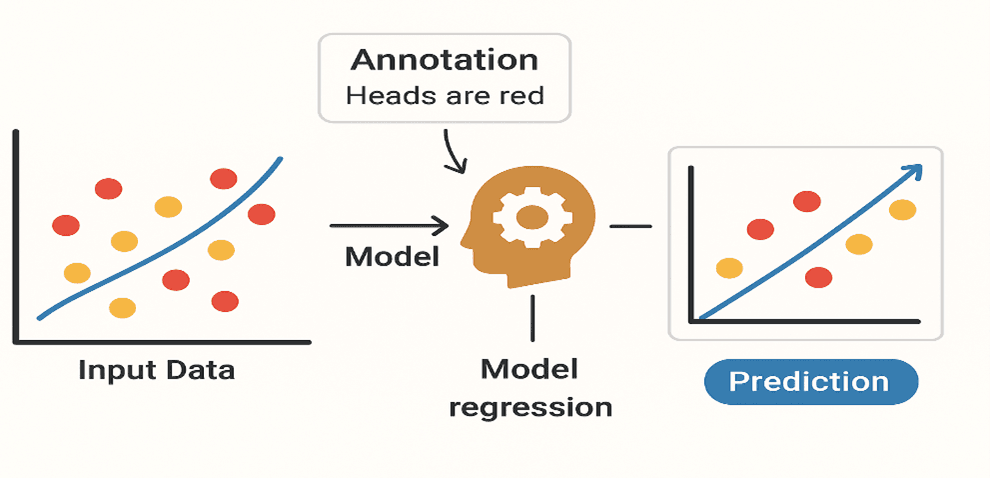
- Despite its name, it’s used for classification, not regression!
- It draws an invisible curve to separate categories like “spam” or “not spam.”
- Great for “yes or no” decisions with a simple mathematical twist.
K-Nearest Neighbors (KNN)
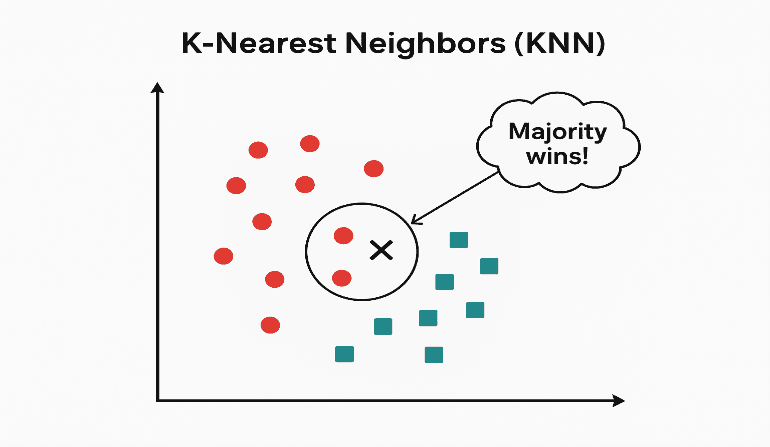
- Imagine asking your neighbors what they think the majority wins!
- It looks at the closest data points and decides based on what most of them are.
- No training phase – it just stores data and compares when needed.
Support Vector Machine (SVM)
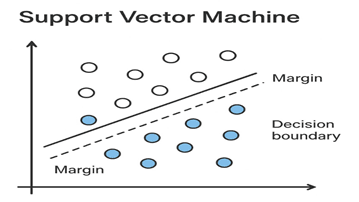
- Picture drawing the widest possible line between two groups of data.
- SVM finds that perfect line (or curve) and keeps data on either side as far apart as possible.
- Works great when the separation is clear like a referee with a whistle.
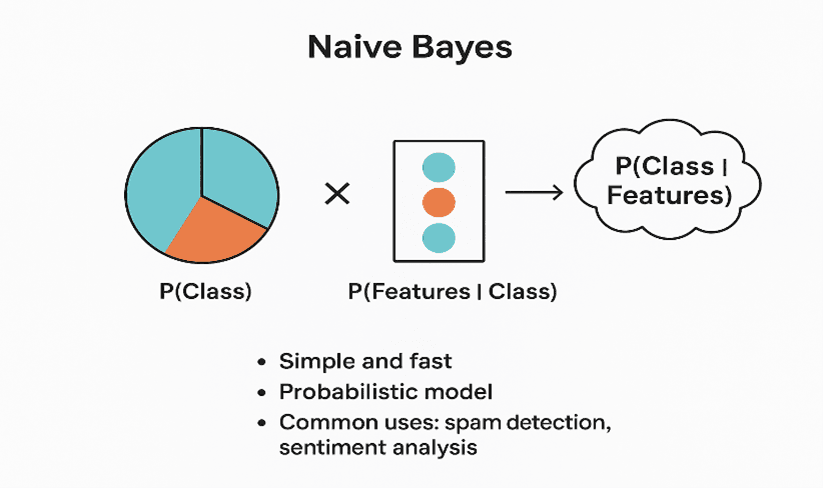
Naive Bayes
- It’s like making decisions based on probabilities but it “naively” assumes features are independent.
- Used in spam filters: if words like "free" and "winner" show up, it's probably spam.
- Fast, simple, and surprisingly smart for its assumptions.
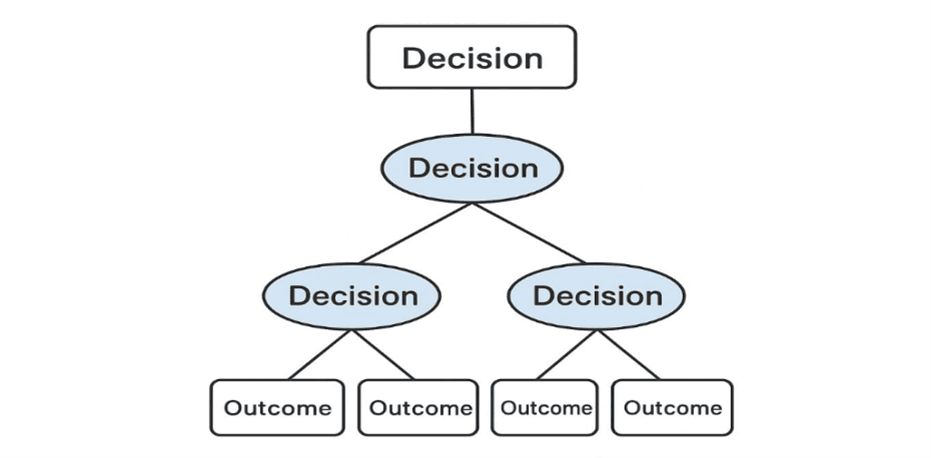
Decision Tree
- It’s like a flowchart quiz: “Is it sunny?” → “Go out” or “Stay in.”
- Each question (split) narrows things down until you reach a conclusion.
- Super intuitive and great for understanding how decisions are made.
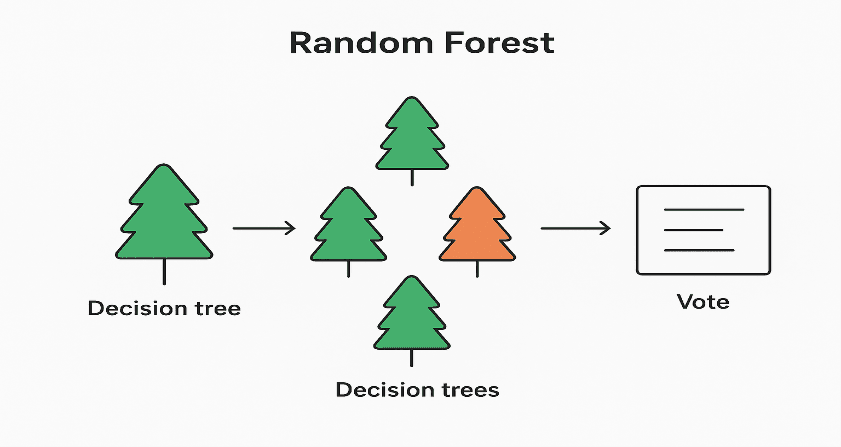
Random Forest
- Now imagine a forest of decision trees, each giving their opinion.
- It takes a vote from many trees to make a stronger, more accurate decision.
- Less prone to errors or overfitting than a single tree.
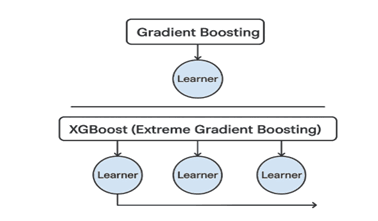
Gradient Boosting
- This is like a team of learners working one after another, fixing each other's mistakes.
- Each new model tries to correct the errors of the previous one.
- It’s slow but powerful. Think of it as a perfectionist tutor.
XGBoost (Extreme Gradient Boosting)
- Think of it as Gradient Boosting on steroids faster, smarter, and more powerful.
- It builds trees one at a time, each fixing the last one's mistakes, but with clever tweaks (like regularization) to avoid overfitting.
- Used by data scientists in competitions because it often wins its like the champion race car of machine learning!
Where Supervised Learning Powers Our World
Supervised learning isn’t just theory, it's happening all around us, every single day!
Image Recognition: Your phone camera can instantly recognize faces, cats, dogs, or landmarks because algorithms have learned from millions of labelled images.
Email Filtering: Spam emails don’t stand a chance supervised learning helps your inbox separate the junk from what’s important.
Healthcare: AI predicts diseases, spots tumours in scans, or forecasts patient risks by learning from medical data.
Finance: Banks use it to detect fraud, estimate credit scores, and suggest personalized offers.
E-commerce & Streaming: Netflix, Amazon, and Spotify recommend movies, products, and songs based on your past behaviour.
In short, supervised learning transforms raw data into smart decisions, making apps, services, and systems smarter sometimes without us even noticing.
Why Supervised Learning Rocks… and Its Limits
Supervised learning is like a super-smart student: it learns fast, predicts well, and improves with practice. But just like any student, it has its strengths and weaknesses.
Why it rocks:
Quick Learner: Once given labelled data, it can spot patterns and make predictions fast.
Accurate Decisions: It’s great at tasks like spam detection, face recognition, or predicting prices.
Versatile: Works with numbers, categories, images, and text basically anything you can label.
Where it struggles:
Needs Labelled Data: It can’t learn if you don’t already tell it the answers.
Not Great with Surprises: If it sees something very different from its training data, it can get confused.
Time-Consuming to Prep: Collecting and labelling data takes effort and time.
In short, supervised learning is powerful but picky; it shines with good examples but struggles when thrown into the unknown.
The Magic Behind Smart Machines: Conclusion
From recognizing your favourite cat video to predicting tomorrow’s weather, supervised learning is the silent teacher behind the AI we rely on every day.
By learning from examples, spotting patterns, and improving with practice, these algorithms turn raw data into smart decisions. Sure, they need guidance, and they stumble when faced with the unexpected but with good data and clever algorithms, their potential is limitless.
The next time your phone, computer, or favourite app surprises you with a spot-on prediction, remember it all started with labelled examples, a curious algorithm, and the magic of supervised learning.
If you're eager to dive deeper into the realm of data science and artificial intelligence, AlmaBetter offers structured programs designed to equip you with the skills needed in today's tech landscape. Their courses, such as the Professional Certification in Data Science and AI Engineering, provide hands-on experience with real-world projects, ensuring you're job-ready upon completion. Embark on your learning journey with AlmaBetter and transform your understanding of AI into actionable skills.
Additional Readings:
For a complementary, well-structured tutorial on supervised learning, check out the “Introduction to Supervised Learning” article by AlmaBetter. It covers the fundamentals of how supervised learning uses labeled input output pairs, walks through application examples (like fraud detection and image classification), and discusses common challenges such as data imbala\nce and limited labeling.
Link: https://www.almabetter.com/bytes/tutorials/data-science/supervised-learning