





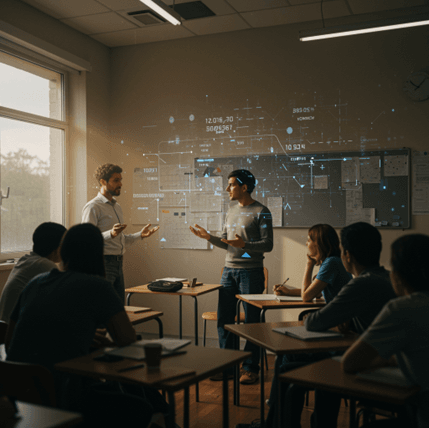
Nobody announced it. No orientation, no faculty memo, and no "Welcome AI" cupcakes. It simply appeared one morning – whispering answers, assessing essays, predicting learning gaps, and sometimes hallucinating facts — and classrooms were unexpectedly graced with a new guest no one had asked but on whom many now relied.
This is what "Teaching in the Age of AI" feels like: the familiar environment of chalkboards, student eyes, and instructor patience, but now shared with an invisible, mercilessly efficient partner. It raises urgent questions. What happens when a machine responds instantly? What happens when an algorithm determines who wrote what, who skipped class, and who posed which question? Above all, what remains sacrosanct when artificial intelligence invades the classroom?
In this blog, we look at that seismic shift: the potential and risks of AI in education, the art of integrating AI-powered teaching methods without losing human warmth, and what it takes to keep learning human in the face of a rapidly evolving AI in the current educational system.
Why AI is Already in Class—and Why That's Both Exciting and Terrifying.
The introduction of AI into classrooms has not been gradual; it has been a tempest. Within a few years, instruments capable of automatic grading, personalised learning routes, and adaptive assessment had gone from experimental labs to classroom lesson plans. According to a recent World Economic Forum (WEF) research, AI's biggest potential in education is not to replace teachers, but to liberate them from tedious tasks so they can focus on connection, mentorship, and caring.
In that sense, AI's arrival seems unavoidable. Global education systems are trying to catch up, rethinking not only "how" but also "what" they should teach. The OECD strongly believes that as AI and robotics revolutionise the way the world works, curriculum must shift to emphasise skills such as creativity, critical thinking, evaluation, teamwork, and ethical reasoning rather than rote knowledge.
However, the rapid introduction of AI poses significant, often invisible hazards — particularly if we treat it as just another "ed-tech upgrade."
We've already seen evidence of this. A recent Guardian article highlighted how alarming phenomena such as AI-generated deepfake pornography, which was formerly only seen in dystopian futures, are currently circulating among schoolchildren. In one terrifying incident, a 15-year-old girl was subjected to a deepfake manufactured by her peers; she was so traumatised that she refused to attend school.
That is not a glitch. It's a warning indication that artificial intelligence in education is about more than just efficiency and ease. It concerns power, privacy, ethics, and identity.
Consequently, the stakes are considerable. This isn't only about getting better grades or faster grading. The question is whether schools will become safer human environments or computational factories.
What "Good" AI-powered Teaching Methods Might (and Should) Look Like
Let's play with a vision. A form of education in which AI does not steal the show, but instead quietly assists the people who matter: students, instructors, and the community.
This vision is heavily based on UNESCO's ideas, which advocate for a "pedagogy-first" model: a system in which human judgement, context, empathy, curiosity, and care take precedence; AI assists.
Here are some examples of what that might look like:
- Personalisation without alienation.
Adaptive-learning systems provide practice exercises based on each learner's pace. However, rather than bypassing the instructor, the method frees them up, allowing the teacher to group pupils wisely, conduct peer conversations, foster curiosity, and cease overscheduling every minute. AI handles the mechanics, while teachers handle the meaning.
- Support, not substitution—particularly for emotional and social care.
AI can track progress and identify who is falling behind, but only humans can tell whose stillness belies anxiety, whose laughter masks loneliness, and whose grades conceal burnout. As the World Economic Forum highlights, caregiving and a sense of belonging are often more important than content delivery.
- AI as a mirror—a tool for reflection, not control.
Consider AI dashboards that provide class participation trends but, rather than evaluating students, assist teachers in reflecting on who never talks. Who asks indirect questions? Teachers can utilise the data to create more equal and inclusive debates. This maintains the teacher's agency and humanity in the classroom.
- The OECD suggests including ethics, critical thinking, and AI literacy into the curriculum. Schools should consider which competencies are relevant in a world when robots can outperform humans in writing, translation, and calculation. The answer must involve not only technical skills, but also judgement, ethics, creativity, teamwork, and empathy.
What Must Shift—Rethinking Curriculum, Pedagogy, and What Education Mean
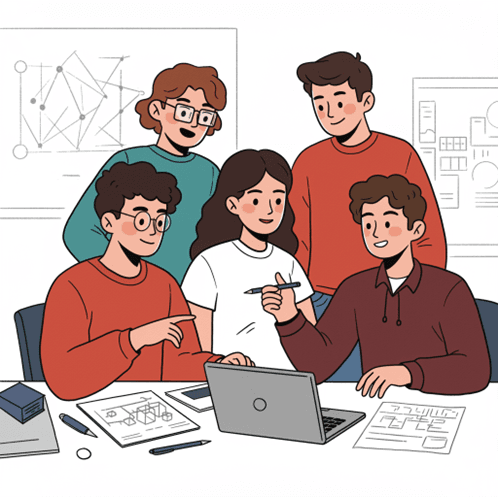
If artificial intelligence becomes deeply ingrained in education, what and why we educate will have to shift profoundly.
The traditional methodology of acquiring facts, memorising them, and providing standardised responses was already being challenged by internet-enabled search engines and online encyclopaedias. AI multiplies the challenge a hundredfold. As the OECD points out, when facts become irrelevant, what remains essential is how we interact with ideas – how we understand, critique, connect, and question.
Therefore, curricula should evolve. This is a rough framework:
- Foundational AI literacy (for educators and students): Not just usage, but also understanding of constraints, biases, privacy, and repercussions.
- Critical thinking and ethical reasoning: "Why did the AI output this?" What assumptions underpin it? "Who benefits?"
- Encourage work that AI cannot replicate—multidimensional projects, context-rich reflections, transdisciplinary difficulties, and community-based learning.
- Empathy, teamwork, conflict resolution, and civic awareness are examples of uniquely human talents that machines struggle to replicate.
- Adaptive, flexible assessment: less standardised tests, more portfolios, reflections, peer assessments, and oral debates — genuine expressions over algorithm-friendly templates.
If we do this successfully, the end result will be more than just faster grading and better classrooms. It will be a return to the original purpose of education: human development rather than content dumping.
The Real Danger: What Happens When We Hand Over the Classroom to the Algorithm
Because here's the truth: if we embrace AI as an efficiency hack, we risk transforming classrooms into factories.
If we rely too heavily on AI for lesson design, grading, and evaluation, teaching will become an assembly line. Teachers become technicians, pupils become data points, and education becomes optimisation. As UNESCO warns, the so-called "human-in-the-loop" metaphor might be misleading: it risks reducing humans to mere afterthoughts while robots take over.
Beyond that, there are serious risks, such as deepfake misuse (as we witnessed), expanding disparities as only some schools have access to AI tools, and losing trust in authentic human interaction. If AI becomes the classroom default, students who rely only on technology risk missing out on complexity, empathy, ethics, and what it means to belong in a community.
According to new data, many educators feel underprepared. A recent academic evaluation of AI use in higher education discovered that, while 92% of students utilised AI tools to save time or enhance work quality, only 36% received official supervision, and just 14% of educators felt comfortable utilising those technologies.
In other words, a shadow pedagogy is already developing. One based on silence, gaps, uneven access, and ethical ambiguity.
If we do not act with caution, diligence, and intention, we risk changing not only material delivery, but the whole essence of education.
What Teachers Must Do: The New Role for Educators in an AI-Powered World.
If artificial intelligence becomes a part of the current educational system, teachers' roles must develop rather than disappear. Here is how.
Teachers serve as curators, mentors, and moral anchors.
Curators choose which AI technologies to utilise (or reject), ensuring they are consistent with educational ideals.
Mentors focus on guidance, discussion, shared meaning, and emotional support.
Moral anchoring - Encouraging pupils to consider AI use, ethics, equity, and fairness.
As UNESCO puts it, education should be co-constructed rather than maximised. AI should function as a co-agent rather than a ruler.
Develop teacher AI literacy and agency.
To trust and use AI properly, instructors must become literate, not just technically, but also ethically and pedagogically. Experts at the OECD advocate for ongoing professional development, peer learning, and teacher leadership so that educators become decision-makers rather than passive followers.
Emphasis on equity and inclusion.
AI should not be limited to affluent schools. If we truly believe that education is a social good, technology must become a public good—accessible, inclusive, and deployed with consideration for local context, culture, language, and resources. UNESCO identifies this as a key concept.
Protect the Human Core of Learning.
Use AI to free up time, allowing you to ask difficult questions, foster curiosity, create trust, and inspire awe. Use AI to supplement, not replace. Use AI to provide breathing room, not to sterilise.
What AI Can — and Can’t — Do
| Area of Education | What AI Brings (When Used Right) | What Only Humans Bring |
|---|---|---|
| Content delivery & facts | Instant access to information; personalized pace; adaptive exercises | The ability to question, contextualize, explore nuance, and foster curiosity |
| Grading & feedback (mechanical aspects) | Fast grading of multiple-choice/grammar assessments; automated feedback | Emotional nuance, encouragement, critical and creative feedback, mentorship |
| Administrative / clerical tasks | Automating attendance, record-keeping, and performance data tracking | Sense of fairness, human discretion, empathy, and pastoral care |
| Learning planning | Data-driven learning paths; personalized difficulty adjustment | Pedagogical judgment, community and context awareness, cultural sensitivity |
| Language & translation support | Bridging language divides quickly; enabling multilingual inclusion | Cultural meaning, local idioms, contextual understanding, emotional resonance |
| Student engagement & motivation | Interactive tasks; adaptive challenge levels; responsive learning pace | Inspiration, human connection, mentorship, and social bonding |
What A Balanced, Human-Centered Future Might Look Like
Imagine a school — maybe somewhere in Bengaluru, maybe your hometown — 10 years from now:
- Students use a learning platform that adapts to their pace and style.
- On Monday evenings, the teacher does not grade but rather prepares for a climate justice debate, fostering critical speech.
- A student who suffers with language receives AI-powered translation assistance; but, during class, the teacher asks the group to explore the cultural, ethical, and emotional implications of what was translated.
- Homework comprises a creative project, such as sketching, writing, building, or reflecting, which AI cannot accomplish meaningfully.
- The teacher reviews AI analytics not to monitor performance, but to design collaborative group work, to give quiet students space, and to urge those who are always in the rear to raise their hands.
- Parents meet instructors the way they used to – not to fight about grades, but to chat about growth, values, dreams.
In that future, AI in education serves as a supporting actor rather than a star. However, the human lead remains.
That is how integrating AI into the modern educational system should feel. A fusion of efficiency and empathy, data and dignity, speed and soul.
Final Warning (and Hope).
We're at a crossroads. The emergence of AI in schools might result in more efficient, personalised, and inclusive teaching — or classrooms where human voices fade, ethics weaken, and connections evaporate.
If policy-makers, educators, students and communities merely adopt AI because it’s new or “better,” we risk developing a system that prioritises measurements over meaning.
However, if we adopt AI thoughtfully, focussing on pedagogy, agency, equity, and empathy, we may be able to spark a renaissance in education. One in which learning grows more humane, not less.
The opportunity is real. The threat is genuine. What we pick now will determine whether future schools produce individuals or algorithms.
Additional Readings
https://www.weforum.org/stories/2025/12/ai-is-transforming-education-by-allowing-us-to-be-more-human/
https://www.oecd.org/en/publications/what-should-teachers-teach-and-students-learn-in-a-future-of-powerful-ai_ca56c7d6-en.html
https://www.theguardian.com/society/ng-interactive/2025/dec/02/the-rise-of-deepfake-pornography-in-schools
https://www.unesco.org/en/articles/beyond-loop-reclaiming-pedagogy-ai-age
https://www.oecd.org/en/publications/what-should-teachers-teach-and-students-learn-in-a-future-of-powerful-ai_ca56c7d6-en.html
https://www.oecd.org/en/publications/what-should-teachers-teach-and-students-learn-in-a-future-of-powerful-ai_ca56c7d6-en.html
https://www.unesco.org/en/articles/beyond-loop-reclaiming-pedagogy-ai-age