
Your Success, Our Mission!
6000+ Careers Transformed.
In the real world, user preferences are complex and cannot always be captured by a single recommendation approach. Traditional systems — whether content-based or collaborative — often face limitations such as the cold-start problem, data sparsity, or lack of contextual understanding.
Hybrid and Context-Aware Systems aim to overcome these challenges by intelligently combining multiple learning strategies and incorporating rich contextual signals like time, location, and user behavior patterns.
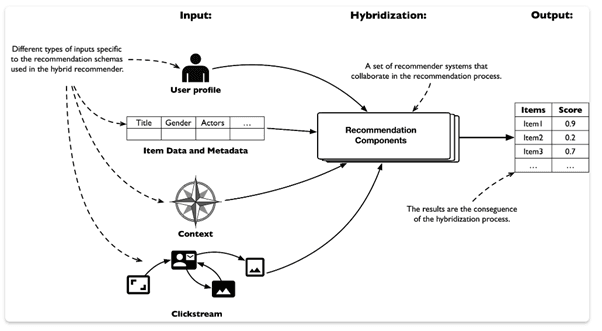
This module explores how hybrid architectures merge the strengths of different models, and how modern context-aware and graph-based techniques push recommendation quality to the next level.
Hybrid recommendation systems bring together the strengths of content-based and collaborative filtering methods to achieve superior performance and flexibility. Content-based systems rely on item attributes — such as movie genres, product descriptions, or tags — to recommend similar items to what a user already likes. Collaborative filtering, on the other hand, focuses on patterns in user behavior — learning that “users who liked X also liked Y.” Each approach alone has limitations: content-based systems can’t easily recommend new types of items a user hasn’t seen, while collaborative systems struggle with the “cold start” problem when there’s not enough data.
By merging the two, hybrid systems can use item features to fill in the gaps where user interaction data is sparse, and vice versa. For example, in a movie platform like Netflix, if a new user has watched only two sci-fi films, a pure collaborative system would have limited data to work with. But a hybrid system can leverage the content features of those movies — such as genre, cast, and keywords — to find similar titles, while gradually incorporating collaborative patterns as the user interacts more.
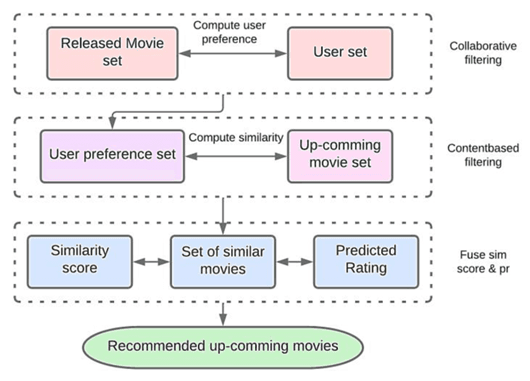
Modern hybrid recommenders often use deep neural networks to combine both forms of information. Separate network branches can process user-item interaction data (collaborative) and metadata like text or images (content), merging them into a unified latent representation. This architecture enables the system to learn joint embeddings that reflect both semantic meaning and collective behavior, leading to recommendations that are accurate, diverse, and contextually relevant. In essence, hybrid models are the practical backbone of large-scale recommendation engines in production systems.
Implementing a hybrid model in Python involves constructing a pipeline that integrates both content features and collaborative embeddings. Libraries such as Scikit-learn, TensorFlow, and PyTorch make this process intuitive. The workflow typically begins with preparing the data: generating TF-IDF vectors for text-based features or encoding categorical attributes, and simultaneously computing user–item interaction matrices for collaborative learning (for example, using Singular Value Decomposition or Neural Collaborative Filtering).
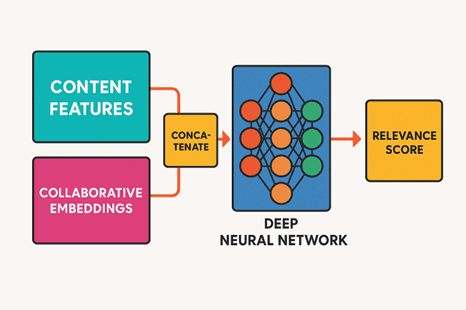
Once these feature sets are ready, they are concatenated into a single feature space. A deep neural network is then trained to learn nonlinear relationships between users and items using these combined features. The model’s output layer usually predicts a relevance score or a probability of user interaction. Over time, the model learns to assign dynamic importance to each data type — sometimes prioritizing collaborative signals, sometimes relying more on item metadata — depending on which yields better predictive accuracy for a given context.
This approach allows for better generalization and robustness. For example, a hybrid system can continue making meaningful recommendations even when new products are introduced (cold start), or when user behavior data is temporarily limited. Such flexibility makes hybrid systems the preferred choice in large-scale applications like Spotify, Amazon, or Netflix, where multiple types of data — text, audio, visuals, and interactions — coexist in the same ecosystem.
Top Tutorials

Python
Python is a popular and versatile programming language used for a wide variety of tasks, including web development, data analysis, artificial intelligence, and more.
SQL
The SQL for Beginners Tutorial is a concise and easy-to-follow guide designed for individuals new to Structured Query Language (SQL). It covers the fundamentals of SQL, a powerful programming language used for managing relational databases. The tutorial introduces key concepts such as creating, retrieving, updating, and deleting data in a database using SQL queries.
Data Science
Learn Data Science for free with our data science tutorial. Explore essential skills, tools, and techniques to master Data Science and kickstart your career

 in Bengaluru, India


All Courses (6)
Master's Degree (2)
Fellowship (2)
Certifications (2)

 Hybrid Deep Recommendation Models