

Your Success, Our Mission!
6000+ Careers Transformed.
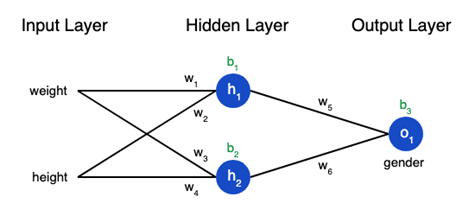
Artificial Neural Networks (ANNs) are the foundation of deep learning. They are inspired by how the human brain processes information through interconnected neurons. In an ANN, each artificial “neuron” receives numerical inputs, performs a small computation, and passes the output forward — similar to how biological neurons communicate through electrical signals.
A single artificial neuron performs three key operations:
Sends the output to the next layer — Layers are stacked to form a network capable of learning hierarchical patterns.
import tensorflow as tf
from tensorflow import keras
from tensorflow.keras import layers

model = keras.Sequential([
    layers.Dense(8, activation='relu', input_shape=(4,)),
    layers.Dense(3, activation='softmax')
])
model.summary()
Model: "sequential"
_________________________________________________________________
 Layer (type)                Output Shape              Param #
 =================================================================
 dense (Dense)               (None, 8)                 40

 dense_1 (Dense)             (None, 3)                 27

 =================================================================
Total params: 67 (268.00 Byte)
Trainable params: 67 (268.00 Byte)
Non-trainable params: 0 (0.00 Byte)
_________________________________________________________________
From the output, you can see that:
This simple ANN can learn patterns from structured data — such as numbers, tabular data, or basic classification tasks. However, when dealing with high-dimensional inputs like images, where spatial relationships matter, a standard ANN becomes inefficient. This challenge is what led to the development of Convolutional Neural Networks (CNNs), which you’ll explore next.
Top Tutorials

Python
Python is a popular and versatile programming language used for a wide variety of tasks, including web development, data analysis, artificial intelligence, and more.

SQL
The SQL for Beginners Tutorial is a concise and easy-to-follow guide designed for individuals new to Structured Query Language (SQL). It covers the fundamentals of SQL, a powerful programming language used for managing relational databases. The tutorial introduces key concepts such as creating, retrieving, updating, and deleting data in a database using SQL queries.

Data Science
Learn Data Science for free with our data science tutorial. Explore essential skills, tools, and techniques to master Data Science and kickstart your career

 in Bengaluru, India



All Courses (6)
Master's Degree (2)
Fellowship (2)
Certifications (2)

 What is Deep Learning?


 in Bengaluru, India