

Your Success, Our Mission!
6000+ Careers Transformed.
Given its O(n²) time complexity, it's clear that Bubble Sort is not the right choice for large-scale, performance-critical applications. You won't find it powering a search engine or sorting millions of user records in a database. So, does it have any real-world use at all?
The answer is yes, but its value lies in its simplicity, not its speed. Its primary application isn't in industrial software but in a place that's just as important: education. In this section, we'll explore the specific niches where Bubble Sort's straightforward logic makes it the perfect tool for the job.
The single most important application of Bubble Sort is in education.
When you're first learning programming or data structures, you don't start with the most complex, efficient algorithms. You start with the ones that are easiest to understand, and Bubble Sort is the king of simplicity.
It is often the very first sorting algorithm taught in computer science courses. Its logic is intuitive and doesn't require understanding complex concepts like recursion (like Merge Sort or Quick Sort) or advanced data structures.
It provides a solid foundation. By understanding why Bubble Sort works (and why it's slow), students can then appreciate the cleverness and efficiency of more advanced algorithms.
It's an excellent exercise for beginners to practice fundamental concepts like nested loops, array indexing, conditional statements (if), and writing functions in C.
Following its educational use, Bubble Sort is the most easily visualized sorting algorithm. Its "bubbling" action is not just a concept; it's a literal description of what's happening.
This makes it a favorite for visualization in learning environments:
If you search for "sorting algorithm visualizer" online, you'll see Bubble Sort represented by bars swapping places. It's slow, methodical, and you can clearly see the largest "bubbles" (the largest values) rising to the top (the end of the array) with each pass.
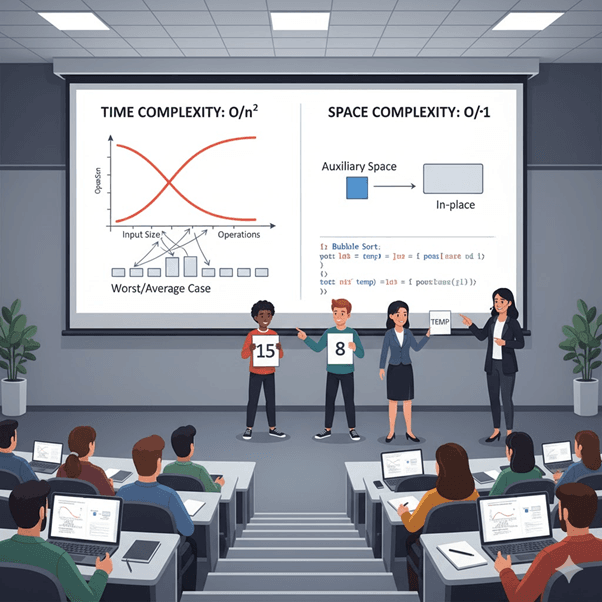
A professor can easily demonstrate it. You can ask 5 students to stand in a line holding random numbers and then have them "run" the algorithm, comparing themselves only to the person next to them and swapping places.
Because it only ever compares two adjacent elements, it's very easy to trace and debug. You can print the array after every single swap to see exactly how it's moving toward a sorted state.
This clear visualization helps solidify the abstract concept of "sorting" into a concrete, step-by-step process that students can see, trace, and understand.
Top Tutorials
Related Articles

 in Bengaluru, India


All Courses (6)
Master's Degree (2)
Fellowship (2)
Certifications (2)


 Educational and Demonstrative Uses


 in Bengaluru, India