

Your Success, Our Mission!
6000+ Careers Transformed.
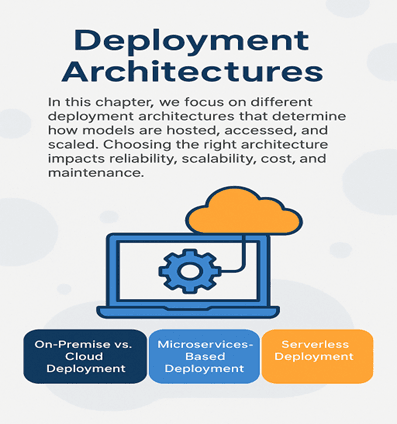
In this chapter, we focus on different deployment architectures that determine how models are hosted, accessed, and scaled. Choosing the right architecture impacts reliability, scalability, cost, and maintenance. We will explore on-premise versus cloud deployment, microservices-based deployment, and serverless deployment approaches, highlighting their strengths, weaknesses, and real-world applications. By the end of this chapter, you will understand how deployment architecture shapes the performance and usability of your ML models.
Machine learning models can be deployed either on-premise or on the cloud. Each approach has its own advantages and trade-offs:
1. On-Premise Deployment:
- The model is hosted on servers physically located within an organization’s infrastructure.
- Common in environments where data privacy, security, or regulatory compliance is critical.
- Gives organizations full control over hardware and resources.
Advantages:
- Full control over data, infrastructure, and security.
- No dependency on internet connectivity for serving predictions.
Challenges:
- High upfront costs for hardware, servers, and maintenance.
- Scaling requires manual setup and additional resources.
- Upgrades and updates can be slower.
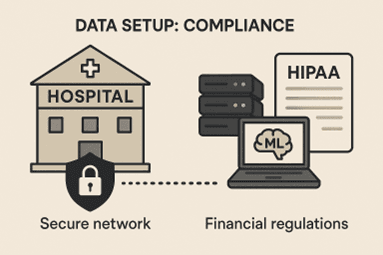
Example: A hospital hosting a diagnostic model within its own secure network to ensure compliance with HIPAA regulations.
2. Cloud Deployment:
The model is hosted on cloud platforms such as AWS, Google Cloud, or Azure.
Popular due to ease of scaling, low upfront costs, and managed infrastructure.
Advantages:
Quick setup with minimal hardware requirements.
Easy to scale with demand using cloud-managed services.
Access to additional tools like monitoring, logging, and automated scaling.
Challenges:
Dependence on internet connectivity.
Ongoing operational costs.
Potential data privacy concerns if sensitive data is sent to the cloud.
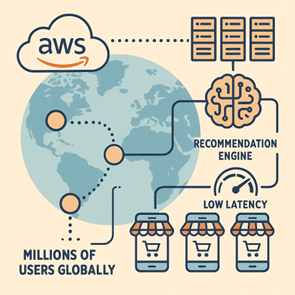
Example: An e-commerce recommendation model deployed on AWS to serve millions of users globally with low latency.
Microservices architecture is a modern approach where different components of an application are split into independent services. In ML, this often means separating:
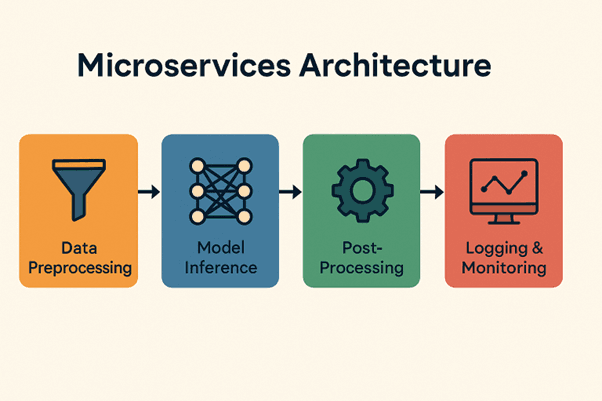
- Data preprocessing
-Model inference
- Post-processing
- Logging and monitoring
Advantages:
Scalability: Each service can scale independently based on demand.
Flexibility: Easier to update, replace, or improve individual components without affecting the entire system.
Fault Isolation: Failures in one service do not crash the entire system.
Example: A recommendation engine might have separate services for:
- Collecting user behavior data
- Generating recommendations using the ML model
- Serving results through an API to the website
Challenges:
- More complex to implement compared to monolithic architectures.
- Requires orchestration tools like Docker Compose or Kubernetes.
Serverless Deployment
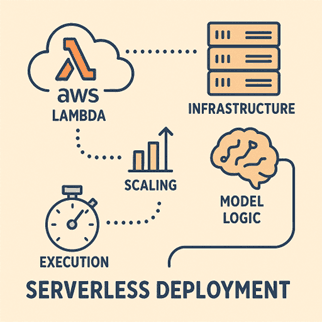
Serverless deployment abstracts server management from the developer. Platforms like AWS Lambda, Google Cloud Functions, or Azure Functions handle infrastructure, scaling, and execution, allowing you to focus purely on the model logic.
Advantages:
- No server management required.
- Automatic scaling based on requests.
- Cost-effective: pay only for the compute used.
Challenges:
- Limited execution time (function timeouts).
- Not suitable for long-running or resource-intensive models.
- Cold start latency can impact response time for infrequent requests.
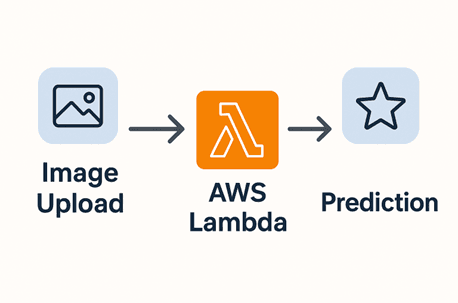
Example: A lightweight image classification model hosted on AWS Lambda that processes images uploaded by users and returns predictions in seconds.
Choosing the right deployment architecture is critical for model performance, reliability, and scalability.
On-premise deployment provides full control and security but requires significant resources.
Cloud deployment is scalable, flexible, and managed but introduces ongoing costs and potential privacy concerns.
Microservices architecture allows modular, scalable, and maintainable ML systems.
Serverless deployment abstracts infrastructure, enabling quick and cost-effective deployment for lightweight models.
Top Tutorials

Python
Python is a popular and versatile programming language used for a wide variety of tasks, including web development, data analysis, artificial intelligence, and more.
SQL
The SQL for Beginners Tutorial is a concise and easy-to-follow guide designed for individuals new to Structured Query Language (SQL). It covers the fundamentals of SQL, a powerful programming language used for managing relational databases. The tutorial introduces key concepts such as creating, retrieving, updating, and deleting data in a database using SQL queries.

Data Science
Learn Data Science for free with our data science tutorial. Explore essential skills, tools, and techniques to master Data Science and kickstart your career

 in Bengaluru, India



All Courses (6)
Master's Degree (2)
Fellowship (2)
Certifications (2)

 Deployment Architectures


 in Bengaluru, India