

Your Success, Our Mission!
6000+ Careers Transformed.
Graph and tree algorithms are methods to traverse, search, and analyze hierarchical or networked data structures. Tree algorithms include traversals like in-order, pre-order, and post-order. Graph algorithms cover BFS, DFS, Dijkstra, and Prim’s for shortest paths, connectivity, and spanning trees, widely used in networks, maps, and data processing.
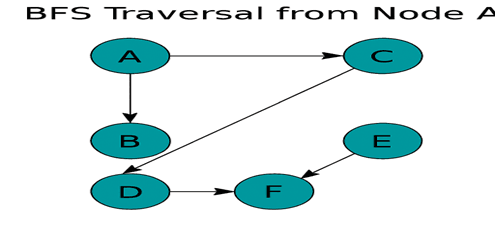
Breadth-First Search (BFS) is a graph traversal algorithm that explores nodes level by level, starting from a given source node. It uses a queue to keep track of nodes to visit next, ensuring that all neighbors of a node are visited before moving deeper.
In Python, BFS can be implemented using a queue from collections.deque. The main operations performed in BFS are:
BFS is widely used in finding the shortest path in unweighted graphs, checking connectivity, social network analysis, and maze or puzzle solving.
Time Complexity: O(V + E), where V is vertices and E is edges.
Example:
Input:
from collections import deque
def bfs(graph, start):
    visited = set()
    queue = deque([start])
    while queue:
        node = queue.popleft()
        if node not in visited:
            print(node, end=" ")
            visited.add(node)
            queue.extend([n for n in graph[node] if n not in visited])

graph = {
    'A': ['B','C'],
    'B': ['D','E'],
    'C': ['F'],
    'D': [],
    'E': ['F'],
    'F': []
}

print("BFS Traversal:", end=" ")
bfs(graph, 'A')
Output:
BFS Traversal: A B C D E F
Graphical Representation of Breadth-First Search Algorithm
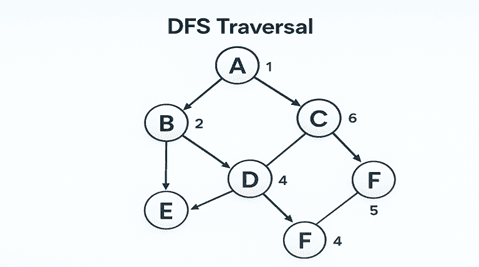
Depth-First Search (DFS) is a graph traversal algorithm that explores as deep as possible along each branch before backtracking. It uses a stack or recursion to keep track of visited nodes, ensuring that each path is fully explored before moving to the next.
In Python, DFS can be implemented using recursion or an explicit stack. The main operations performed in DFS are:
DFS is widely used in pathfinding, puzzle solving, cycle detection, topological sorting, and exploring all possible configurations in graphs.
Time Complexity: O(V + E), where V is vertices and E is edges.
def dfs(graph, node, visited=None):
    if visited is None:
        visited = set()
    visited.add(node)
    print(node, end=" ")
    for neighbor in graph[node]:
        if neighbor not in visited:
            dfs(graph, neighbor, visited)

graph = {
    'A': ['B','C'],
    'B': ['D','E'],
    'C': ['F'],
    'D': [],
    'E': ['F'],
    'F': []
}

print("DFS Traversal:", end=" ")
dfs(graph, 'A')
DFS Traversal: A B D E F C
Dijkstra’s algorithm is used to find the shortest path from a source node to all other nodes in a weighted graph with non-negative edge weights. It repeatedly selects the node with the smallest tentative distance, updates the distances of its neighbors, and uses a priority queue for efficiency.
In Python, Dijkstra’s algorithm can be implemented using a min-heap (priority queue) from heapq. The main operations performed in Dijkstra’s algorithm are:
Dijkstra’s algorithm is widely used in routing algorithms, GPS navigation, network optimization, and shortest path calculations in weighted graphs.
Time Complexity: O((V + E) log V) using a priority queue.
def dijkstra(graph, start):
    nodes = list(graph.keys())
    dist = {node: float('inf') for node in nodes}
    dist[start] = 0
    visited = set()

    while nodes:
        u = min((n for n in nodes if n not in visited), key=lambda x: dist[x], default=None)
        if u is None:
            break
        visited.add(u)
        for v, w in graph[u].items():
            if dist[u] + w < dist[v]:
                dist[v] = dist[u] + w
    return dist

graph = {
    'A': {'B':1, 'C':4},
    'B': {'C':2, 'D':5},
    'C': {'D':1},
    'D': {}
}

print("Shortest distances from A:", dijkstra(graph, 'A'))
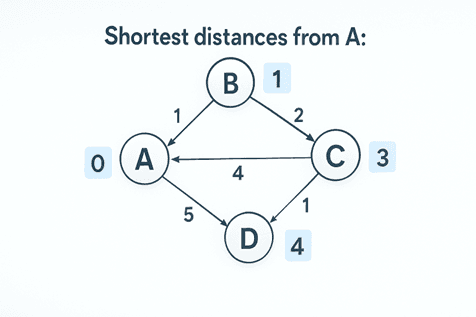
Shortest distances from A: {'A': 0, 'B': 1, 'C': 3, 'D': 4}
Graphical Representation of Dijkstra Algorithm
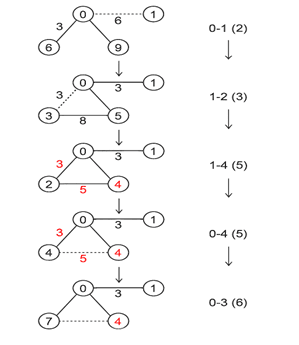
Prim’s Algorithm constructs a Minimum Spanning Tree (MST) of a weighted graph by repeatedly selecting the smallest edge that connects a visited node to an unvisited node. It starts from any node and gradually grows the MST until all nodes are included.
In Python, Prim’s algorithm can be implemented using a priority queue (min-heap) to efficiently select the minimum edge. The main operations performed in Prim’s algorithm are:
Prim’s algorithm is widely used in network design, connectivity optimization, designing efficient electrical grids, and MST-related problems.
Time Complexity: O(V²) for adjacency matrix or O(E log V) with a priority queue.
import sys
g=[[0,2,0,6,0],[2,0,3,8,5],[0,3,0,0,7],[6,8,0,0,9],[0,5,7,9,0]]
s=[0]+[0]*4;e=0
while e<4:
    m,a,b=sys.maxsize,0,0
    for i in range(5):
        if s[i]:
            for j in range(5):
                if not s[j] and g[i][j] and g[i][j]
0-1 (2)
1-2 (3)
1-4 (5)
0-3 (6)
Top Tutorials

Python
Python is a popular and versatile programming language used for a wide variety of tasks, including web development, data analysis, artificial intelligence, and more.

SQL
The SQL for Beginners Tutorial is a concise and easy-to-follow guide designed for individuals new to Structured Query Language (SQL). It covers the fundamentals of SQL, a powerful programming language used for managing relational databases. The tutorial introduces key concepts such as creating, retrieving, updating, and deleting data in a database using SQL queries.

Data Science
Learn Data Science for free with our data science tutorial. Explore essential skills, tools, and techniques to master Data Science and kickstart your career

 in Bengaluru, India



All Courses (6)
Master's Degree (2)
Fellowship (2)
Certifications (2)

 Searching Algorithms


 in Bengaluru, India