







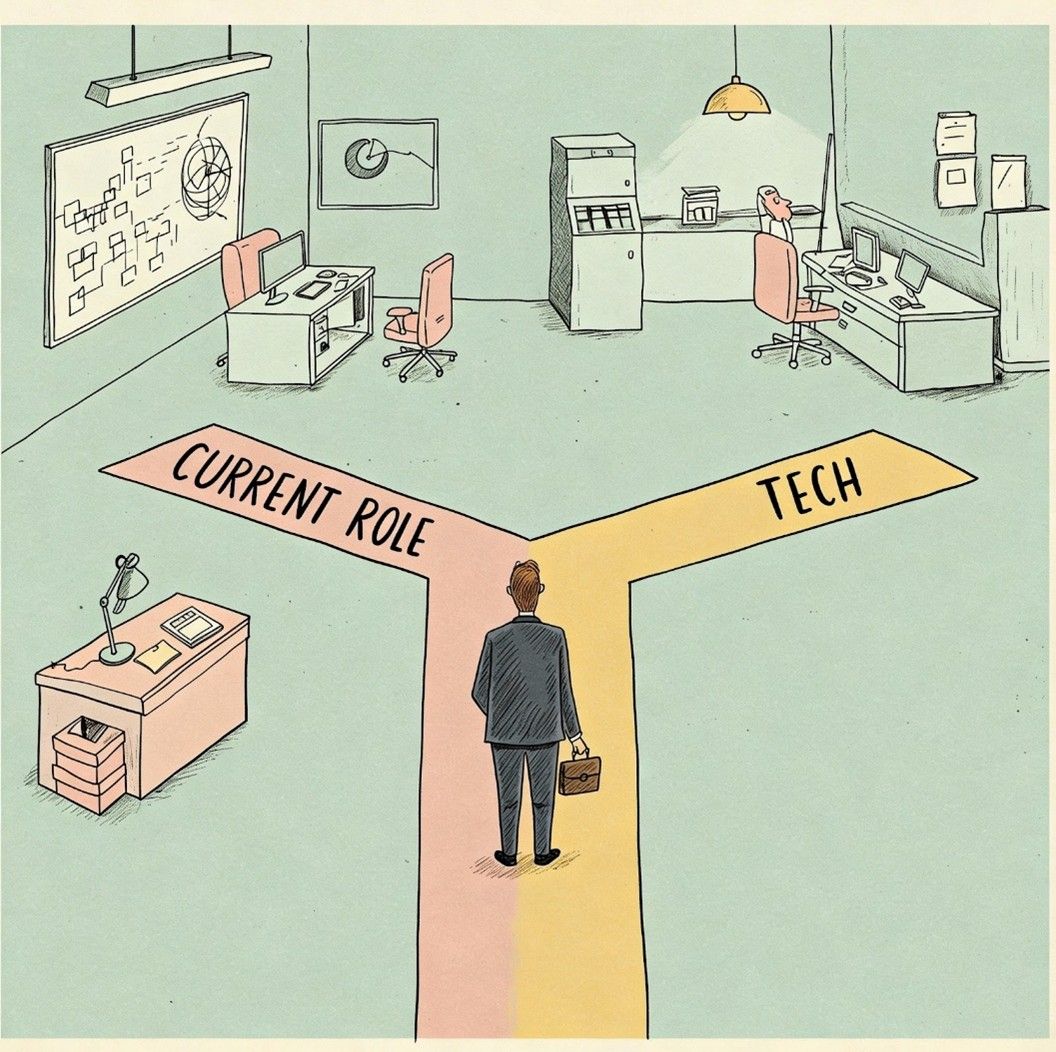
You aren't bad at your work.
You show up. You deliver. You meet expectations. However, there is a sense of limited growth. Salary increases are slow. The roles appear to be more interchangeable. And the future does not seem as solid as it once did.
Many non-tech professionals in their 20s and early 30s, particularly those working in operations, sales, human resources, education, support, finance, or BPO professions, –experience silent dissatisfaction that leads to one question:
"Should I move into the tech industry?"
Not because technology sounds appealing. But it appears to provide greater growth, stability, and long-term importance.
If you've been wondering about coding, math, AI, layoffs, or whether it's "too late," this guide is for you.
Why Is This Question Coming Up For So Many Non-Tech Professionals?
Career transformations rarely start with bold decisions. They usually begin with minor signs that are easy to ignore, until they pile up.
For many non-tech workers, those indications appear as static increments, increasingly transactional roles, and a growing awareness that the work they do today may not be as important tomorrow. Rising living costs and limited professional mobility make the discomfort difficult to disregard.
At the same time, technology continues to dominate discussions about advancement, compensation, and opportunities. Friends from non-technical backgrounds discuss transitioning into analytics, product, or tech-enabled roles. LinkedIn timelines support the concept that "everyone is switching."
This produces tension.
On the one hand, technology seems promising.
On the other hand, news about layoffs and AI disruption makes it appear riskier.
Understanding this conflict is the first step towards making a reasonable, rather than emotional, decision.
Tech Layoffs, AI, and What's Changing
It's critical to be open about the current status of the technology business.
Yes, layoffs have occurred at multinational technology organisations.
Yes, artificial intelligence (AI) tools are automating aspects of software development.
Yes, the "learn to code and get hired quickly" story has faded.
However, these adjustments do not indicate that technology is failing. They indicate that the sector is addressing past excesses and redefining value.
Roles requiring repetitive performance with minimal context are on the decline. Entry-level jobs that require little problem solving are being mechanised or consolidated. Learning routes that focus solely on grammar or tools, with no real-world application, are losing significance.
Roles that require understanding business problems, interpreting data, directing teams, or designing user experiences are becoming more prevalent. These are instances where human judgement is still important, and AI serves as a help rather than a substitute.
For non-tech professionals, this distinction is critical.
The Biggest Misconception About Entering Technology
One myth deters more non-tech workers than any lack of ability:
"To work in tech, I must become a software engineer."
This misperception instills unwarranted dread of coding, mathematics, and age. It also drives people down learning routes that may not match their strengths.
The reality is simpler and more nuanced.
Technology companies are not solely established by engineers. They are assisted by analysts who evaluate data, product managers who set priorities, designers who create user experiences, project managers who ensure delivery, and operations specialists who keep systems functioning smoothly.
Many of these positions demand technical literacy rather than strong technical expertise.
Understanding how technology facilitates decisions is frequently more valuable than learning how to create the technology itself.
A Simple Way to Understand Technical Roles
Instead of thinking of technology as a singular career path, consider it an ecosystem.
At one end are highly technical builder roles, such as software engineers, backend developers, and machine learning specialists. These positions require extensive technical expertise and are quite competitive.
In the midst are translators, who serve as liaisons between business demands and technology. This category includes data analysts, business analysts, product managers, user experience designers, and program managers. They collaborate closely with engineers while focussing on insights, objectives, users, and outcomes.
On the other end are operator positions, which employ technology as a tool rather than a fundamental competence. These include technology-enabled sales, customer success, growth, and operations positions.
The most successful non-tech changes take place in the middle and operator layers, where prior knowledge provides instant value.
Best Tech Jobs for Non-Technical Backgrounds
Data Analyst: A Common and Practical Entry Point.
Data analytics has emerged as one of the most accessible technical careers for non-tech workers.
This is because the role focuses on interpretation rather than sophisticated mathematics. A data analyst's job entails asking the proper questions, cleaning and exploring data, and communicating insights clearly.
Professionals in commerce, finance, operations, human resources, and sales often transfer effectively since they are already familiar with numbers and performance measures, but not within a formal analytical framework.
Learning technologies like SQL, Excel, and visualisation platforms allows them to formalise skills that they previously used informally.
Business Analyst and Operations Analyst Positions
Business analysts work to uncover inefficiencies, define needs, and improve systems. These roles prioritise systematic thinking, documentation, and communication over technical depth.
This move is frequently seamless for professionals who have previously worked in consulting, operations, or process-intensive roles. The capacity to decipher ambiguous challenges and coordinate many stakeholders is a crucial talent.
Technology becomes the medium for implementing answers, rather than the primary focus.
Product Management: Not Beginner-Friendly, but Achievable
Product management is frequently misconstrued as an easy or glamorous technical role. In actuality, it necessitates experience, judgement, and sound decision-making abilities.
Product management is a feasible career path for non-tech professionals with 2-6 years of experience, particularly in operations, marketing, education, or customer-facing roles.
The job entails understanding users, setting priorities, and determining trade-offs within restrictions. While technical knowledge is beneficial, the role is primarily about thinking, not coding.
UX and Design Roles
UX and UI design are durable because they are based on human behaviour. Research, usability testing, and design thinking cannot be completely automated.
Professionals with backgrounds in the arts, humanities, psychology, or creative fields frequently excel here, particularly when empathy is combined with systematic problem-solving.
Tools can be learnt. User comprehension must be developed.
Project and Program Management in Technology
Coordination, timeliness, risk, and delivery are key aspects of project management in technology. For individuals who have previously led teams, clients, or cross-functional initiatives, the transition is less about learning new skills and more about using current ones in a technical setting.
Understanding workflows and dependencies is more important than technical depth.
What Skills Do Non-Technical Professionals Need?
A common mistake is attempting to learn everything at once, including coding, AI, cloud, and tools that may never be used.
Instead, skill development should be intentional.
Non-tech professionals entering the technology field require three things: basic thinking skills, role-specific tools, and a willingness to learn on a constant basis.
Logical reasoning, communication, and problem solving are the foundations. The tools come next: SQL for analysts, Figma for designers, and documentation frameworks for product roles. Finally, the ability to adapt and learn is more important than mastering any one technology.
Structure, rather than speed, is what drives progress.
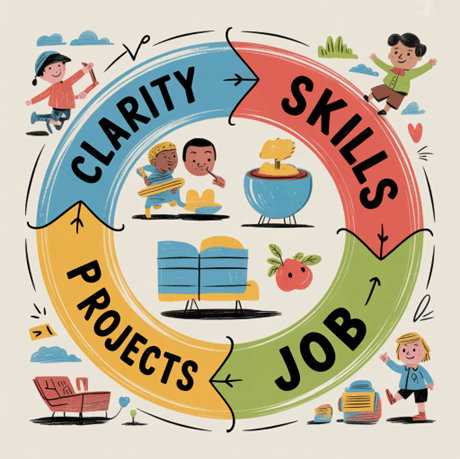
A Realistic Roadmap for the Non-Tech to Technology Transition
Career adjustments take time, and pretending differently causes frustration.
The first stage is clarification. Understanding responsibilities, identifying transferable talents, and selecting a single goal route can save months of wasted effort later.
The second phase focuses on skill development. This is where many students struggle, not because the topic is difficult, but because it is unstructured. Learning without application rarely sticks.
The final part is evidence of work. Projects, case studies, and hands-on problem solving are considerably more effective ways to demonstrate preparation than credentials.
Finally, the job search demands patience and technique. Networking, targeted applications, and role-specific resumes are significantly more important than volume.
A reasonable changeover time is six to twelve months. Anything that promises speedy results should be treated with caution.
Where Structured Learning Can Make a Difference
One pattern emerges consistently among successful profession changers: they do not rely on random tutorials or scattered courses.
An organised learning environment that incorporates core principles, real-world projects, mentorship, and clear hiring expectations might be beneficial.
This is where outcome-focused platforms like AlmaBetter naturally meet the needs of non-tech professionals. Rather than overwhelming students with theory, the emphasis is on practical application, developing skills in data, product, or analytics while constantly integrating learning to real-world employment tasks.
This type of organisation makes it easier for someone making the shift from non-tech to tech. It provides a better sense of progression, feedback, and direction, which are frequently lacking while learning alone.
Importantly, the emphasis is on long-term professional advancement rather than immediate results.
Addressing the Questions Most People Don't Ask Out Loud
Am I too old?
Age is rarely a deciding issue for people aged 21 to 35. Adaptability and clarity are significantly more important.
Is technology still worthwhile without coding?
Yes, for roles that require significant decision-making. Tech literacy is becoming more valuable across businesses.
What happens if I fail?
Career transitions are usually risky. However, remaining in a role with little possibility for advancement and relevance is also an option.
The true question is not whether danger exists, but which risk you are willing to accept.
The Bigger Picture
Technology is not a shortcut.
This is not a promise.
And it is not for everyone.
However, for non-tech workers who approach it carefully, choosing the correct positions, developing actual skills, and following a disciplined path, it remains one of the most realistic strategies to increase long-term career success.
A Last Thought Before You Decide
Do not ask:
"Can I enter tech?"
Ask instead:
"Which tech role fits my background, my learning pace, and my timeline?"
Answer honestly.
Then plan—not emotionally, but strategically.
That is how non-tech professionals enter and remain in the technology field.
Additional Readings:
- https://techcrunch.com/2025/12/22/tech-layoffs-2025-list/
- https://www.businessinsider.com/big-tech-job-market-hiring-cracked-layoffs-amazon-microsoft-2025-12
- https://www.reuters.com/lifestyle/bootcamp-bust-how-ai-is-upending-software-development-industry-2025-08-09/
- https://uxplanet.org/ux-designer-roadmap-2026-ai-vibe-coding-9d3da2f8d690
- https://www.wonsulting.com/job-search-hub/the-career-pivot-playbook-transitioning-from-a-non-tech-role-into-the-tech-industry
- https://www.linkedin.com/pulse/from-non-tech-data-analyst-step-by-step-guide-esther-anagu-mba-ekr6f
- https://skillfloor.com/blog/transitioning-into-data-analytics-from-non-tech-backgrounds
- https://www.letsbeanalyst.com/blogs/content/nonit-it-transitiontips
- https://productschool.com/blog/career-development/transition-product-management-background
- https://www.invensislearning.com/blog/career-change-project-management/
- https://medium.com/@marketingiteyoniks/top-10-non-coding-jobs-in-2025-2026-5a780eafa75d
- https://www.roberthalf.com/us/en/insights/research/data-reveals-which-technology-roles-are-in-highest-demand







 in Bengaluru, India


 in Bengaluru, India