




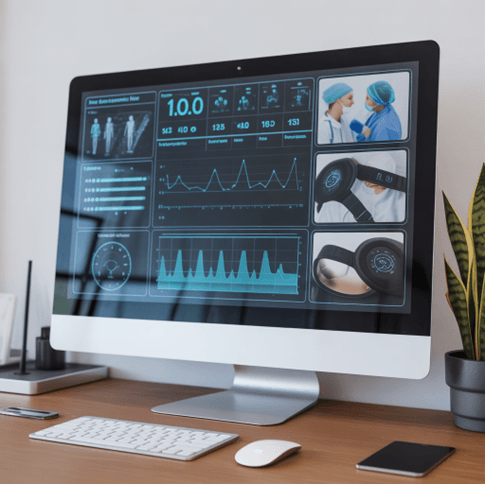
If you spend enough time in hospitals today, you'll see something remarkable. The beeping gadgets and gleaming imaging devices no longer seem to be the focal point. It's the data. It comes in through monitors, wearables, genetic sequencers, imaging systems, and electronic health records. It pulses like the bloodstream of modern medicine. And, just as the cardiovascular system drives the human body, healthcare data science today powers the entire medical ecosystem.
Data are no longer a byproduct of care. It has become the primary driver of care. The impact of data science on healthcare did not occur silently. It rushed in with predictive analytics, real-time monitoring, multi-omics integration, AI-enabled diagnostics, and drug discovery pipelines that run rather than crawl. Clinical deciphering, which once took weeks or months, now completes in seconds.
This post will discuss how this transition is changing data science applications in healthcare and what it means for the future.
Predictive Analytics: Early Diagnosis and Risk Assessment
One of the biggest medical advances is the ability to predict diseases before symptoms appear. It seems futuristic, but it's already occurring. Predictive analytics has evolved into the early warning system of modern healthcare.
Predictive algorithms can accurately stratify risks by analysing electronic health records, imaging, genetics, and lifestyle data. For example, a 2025 study employing CatBoost found that by combining genomic data with lifestyle behaviours, persons at high risk of cancer may be identified with nearly 99 percent accuracy.
This process isn't just about alarms and notifications. Predictive models aid intervention planning. Hospitals can identify patients with the highest likelihood of readmission within 30 days and adjust their follow-up care accordingly. A Midwestern hospital used EHR data to create a predictive framework that assisted them in determining when and how to act with high-risk patients.
What does this scenario look like in everyday life? Assume you wear a smartwatch that silently monitors your heart rate and sleep patterns. If something odd occurs, such as a sudden irregular rhythm or low oxygen saturation, the system will notify your provider immediately. Healthcare data science transforms commonplace signals into lifesaving predictions.
Personalised Medicine and Tailored Treatments
Medicine is transitioning from a universal approach to a personalised one. Data science is the driving force behind that transition. (unlocking next level of personalized medicin)
Oncology is one of the most obvious examples. Companies such as GSK and Tempus use matched clinical and genetic data from thousands of patients to find biomarkers that can predict which medication regimen would be most effective for a certain tumour. A Tempus scientist defined this change as a shift "from single biomarkers to a multimodal approach" that combines genetics, imaging, and pathology to help guide therapeutic decisions.
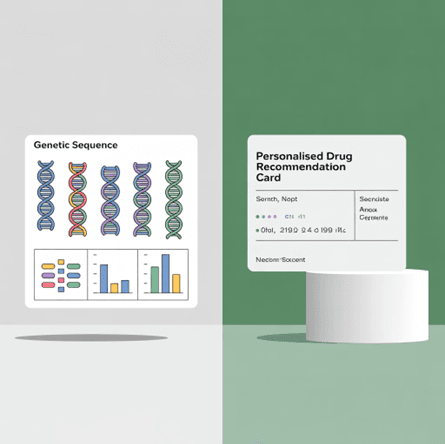
AI-supported pharmacogenomics improves medicine selection precision. Models analyse a patient's genetic variations to forecast how they will respond to antidepressants, cancer medications, and other treatments, rather than trial and error prescribing. For examples of personalised pharmaceutical guidance, check out.
Another innovative notion is the digital twin. Consider it your virtual clone, created from real-time data. As mentioned in a 2024 review in npj Digital Medicine, these models can mimic various treatments and demonstrate how your body may react. It is the closest medicine has gotten to rehearsing your treatment before performing it.
Efficiency and Operations at Hospitals
Let's get out of the lab and walk through a hospital. Behind the scenes, data science is solving some of the most difficult operational problems.
Hospitals utilise forecasting models to predict patient volume by the hour. This allows them to arrange the appropriate amount of nurses and physicians, avoiding long emergency department wait times. As a study demonstrates, anticipating patient loads allows hospitals to allocate workers where they are most needed.
A real-world example comes from Cleveland Clinic Medina Hospital. After reviewing two years of emergency department arrival data, the team discovered that Mondays and Tuesdays were the busiest days. Simply changing staffing to match these peaks reduced the number of patients who left without being seen from 1.42 to 0.42 percent. That is a 70% improvement.
Hospitals also investigate constraints in bed allocation and patient flow. Analytics can help identify where delays occur and how to restructure operations to reduce wait times. This translates directly to cost savings and a better patient experience.
Drug Research and Development
Traditional drug discovery is slow. Painfully slow. It can take ten to fifteen years to get a medicine to market. Data science has begun to significantly compress that timeline.
AstraZeneca has already begun utilising generative AI to create new medicinal compounds in a few of weeks. Their technology analyses biological pathways and molecular interactions to forecast which medicines will be effective against a particular ailment.
Protein structure prediction using AlphaFold2 has revolutionised molecular biology. Instead of spending years in the lab trying to grasp protein forms, researchers can now get exact 3D structures quickly. This advancement speeds up target validation and medication design.
AI is also improving clinical trial efficiency. ML technologies can help identify which patients are best suited for specific trials and anticipate bad outcomes in advance. This results in smaller, faster, and more successful research.
The whole pipeline becomes a constant feedback loop. AI suggests a chemical. The researchers test and validate it. The new insights feed back into the model, improving the next generation of ideas.
Trends in Healthcare Data Science: 2025 to 26
The healthcare scenario from 2025 to 26 appears to be a living ecology of data flowing across wearables, hospitals, personal gadgets, and genomic platforms. There are numerous options available to students and professionals pursuing this sector.
Let's look at the major trends driving this era.
Real-time and predictive analytics become the norm.
Surging data from ICU monitors, distant sensors, and wearables is being processed in real time. According to one source, "Gone are the days of waiting weeks for data to be treated and analysed." Healthcare providers are now making judgements as incidents occur.
Python and R capabilities, real-time data architectures, machine learning modelling, and understanding of clinical workflows are becoming increasingly important for early-career professionals.
Wearables and remote monitoring enable personalised healthcare
Healthcare is expanding beyond the clinic walls. Wearables continuously monitor heart rate, glucose levels, sleep cycles, and activity patterns. Data science combines this with genetics and clinical histories to create a comprehensive picture of health.
Students pursuing this subject must have a thorough understanding of time series modelling and multimodal data processing.
Genomics and multi-omics provide precision medicine.
Data science enables unprecedented personalisation. Genomics and proteomics are being integrated with AI-powered predictive analytics to develop targeted medicines.
Bioinformatics and genetic analytics skills are becoming increasingly valuable.
Ethics and explainable AI take centre stage.
AI in healthcare deals with incredibly sensitive data. The CDC emphasises the importance of privacy first analytics, transparency, and bias mitigation.
By 2026, many big providers will have implemented privacy-enhancing computations such as federated learning and encrypted computation.
Interoperability and data integration will become mandatory.
Incompatible systems are a major source of dissatisfaction in the healthcare industry. Standards such as FHIR and ontology-driven semantic analytics enable systems to communicate with one another.
Skills in data modelling, integration, and informatics are in high demand.
AI expands into diagnosis, imaging, and drug discovery.
A UK and Danish partnership created an AI model that predicts vulnerability to over a thousand diseases decades in advance. Imaging analysis, disease prediction, and medication discovery are becoming increasingly AI-driven.
Augmented Analytics, AutoML, and No-Code platforms gain adoption.
Clinicians with no technological knowledge may now create dashboards, extract insights, and even deploy simple predictive models utilising augmented analytics and AutoML technologies.
Understanding deployment and automated ML platforms is becoming a valuable skill.
Ethics and Privacy Considerations
With tremendous predictability comes great responsibility. Ethical difficulties are not optional responsibilities. They are essential to healthcare data science. The CDC emphasises that maintaining patient anonymity is critical. Strong de-identification and access controls are required to protect health data.
Bias is another major concern. AI models educated on skewed datasets may exacerbate health inequities. Transparent algorithms and diverse training data are critical for preventing inequitable care.
Regulations such as HIPAA (Health Insurance Portability and Accountability Act), GDPR (General Data Protection Regulation), and the forthcoming European Health Data Space keep patient rights at the forefront.
A Handy Comparison Table.
Here's an overview table that summarises how data science affects different domains in healthcare.
| Domain | How Data Science Transforms It |
|---|---|
| Prediction | Early diagnosis, disease prediction, and risk stratification |
| Personalized Medicine | Genomic treatment, pharmacogenomics, and digital twins |
| Operations | Staffing optimisation, process reform, and supply forecasting |
| Drug Discovery | Molecule design, protein structure prediction, and trial optimisation |
| Remote Recovery | Wearable analytics, real-time warnings, and patient monitoring |
Conclusion
Data science is transforming healthcare, from diagnostics to daily operations to medication discovery. It is shifting reactive medicine into proactive medicine, and general care into personalised treatment. The future of healthcare will be more predictive, precise, efficient, and humane because data-driven insights provide us with clarity we have never had before.
And the message is obvious for new students and professionals entering this field. Healthcare data science is more than just a job opportunity. It is an opportunity to engage in one of the most significant transformations in human well-being.






 in Bengaluru, India


 in Bengaluru, India