

Your Success, Our Mission!
6000+ Careers Transformed.
Explanation:
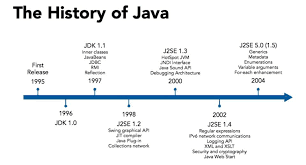
Java’s evolution is a story of continuous innovation driven by the need for portability, security, and robustness in a rapidly changing technological landscape. Developed initially in 1991 under the name Oak, Java was intended for embedded devices like smart televisions. However, its true potential became apparent when the web exploded in the mid-1990s. Java’s ability to run the same bytecode on any machine through the Java Virtual Machine (JVM) became revolutionary.
Over the years, Java has added powerful features:
• Generics in Java 5
• Lambda expressions and Stream API in Java 8
• Modularization in Java 9
• Pattern matching, sealed classes, and records in modern versions
Today, Java is maintained by Oracle and supported by a massive global community, ensuring constant innovation. Java’s backward compatibility ensures that older applications continue to work with modern versions—an attribute highly valued in enterprise systems.
Example:
A legacy Java 6 application can often run unchanged on Java 17 due to strong backward compatibility guarantees.
Table:
| Version | Year | Major Feature | Industry Impact |
|---|---|---|---|
| Java 1.0 | 1996 | First release | Applets revolutionized early web |
| Java 5 | 2004 | Generics, annotations | Stronger type safety |
| Java 8 | 2014 | Lambdas, Streams | Functional programming adoption |
| Java 17 | 2021 | LTS release | Enterprise stability and security |
Technical Example:
// Checking Java version (modern compatibility example)
public class VersionCheck {
    public static void main(String[] args) {
        System.out.println("Running on: " + System.getProperty("java.version"));
    }
}
Use Cases:
• Enterprise companies planning large-scale migrations
• Developers analyzing historical API changes
• Research on programming language evolution
Explanation:
Java was designed with five core principles that guide its architecture and ecosystem:
These principles make Java ideal for applications requiring reliability and cross-platform support. Java also emphasizes multithreading, networking, and dynamic linking, enabling scalable applications such as servers and enterprise platforms.
Example:
Java’s strict type system prevents accidental memory access errors commonly found in languages like C++.
Table:
| Principle | Description | Impact |
|---|---|---|
| Simple | Clean syntax | Faster learning curve |
| Secure | Sandboxed execution | Ideal for distributed apps |
| Portable | Platform-independent | Enterprise adoption |
| Robust | Error-free runtime | High stability |
| OOP | Modular architecture | Large-scale development |

Technical Example:
// Simple demonstration of Java’s robustness using exception handling
try {
    int result = 10 / 0;
} catch (ArithmeticException e) {
    System.out.println("Division by zero prevented.");
}
Use Cases:
• Applications requiring strong security (banking, healthcare)
• Cross-platform desktop or server apps
• Enterprise-scale systems with long-term stability requirements
Top Tutorials

CNN in Deep Learning 2026
A beginner-friendly guide to CNNs: understand deep learning essentials, create Python-based models, and explore advanced applications.

Breaking The Limits: Scaling Databases with MySQL Partitioning
Learn MySQL partitioning with examples. Improve query performance, scalability, and data management using RANGE, LIST, HASH, KEY, and composite techniques.

ML in Action: Hands-On Guide to Deploying and Serving Models
Learn model deployment and serving—from concepts to real-world architectures, tools, APIs, containers, and cloud workflows for production-ready ML.

 in Bengaluru, India


All Courses (6)
Master's Degree (2)
Fellowship (2)
Certifications (2)


 History and Origins




 in Bengaluru, India