

Your Success, Our Mission!
6000+ Careers Transformed.
Explanation:
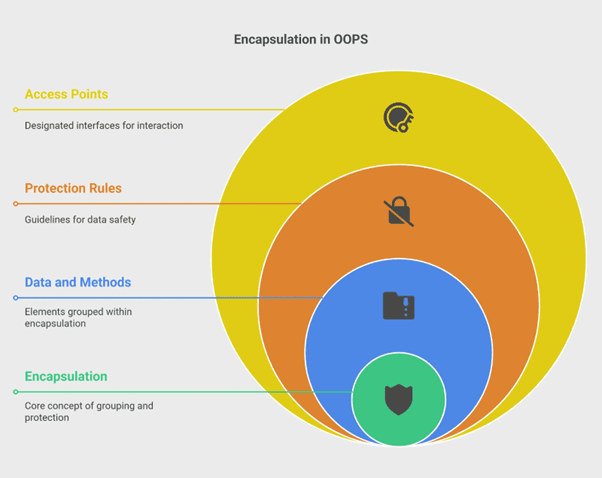
Encapsulation is the process of bundling data and methods within a class and restricting direct external access using access modifiers. It hides internal implementation details and exposes only necessary functionality through getters and setters. Encapsulation promotes maintainability, data protection, and modularity—critical for enterprise-scale systems.
Code:
public class Account {
    private double balance;

    public void deposit(double amount) {
        balance += amount;
    }

    public double getBalance() {
        return balance;
    }
}
| Access Modifier | Visibility | Encapsulation Role |
|---|---|---|
| private | Class only | Protects data |
| public | Everywhere | Exposes controlled access |
| protected | Package + subclass | Extensible design |
Technical Example:
A banking application secures account balance fields through encapsulation to prevent unauthorized modification.
Use Cases:
• Designing secure financial systems
• Modularizing business logic in enterprise apps
• Creating reusable class libraries
Explanation:
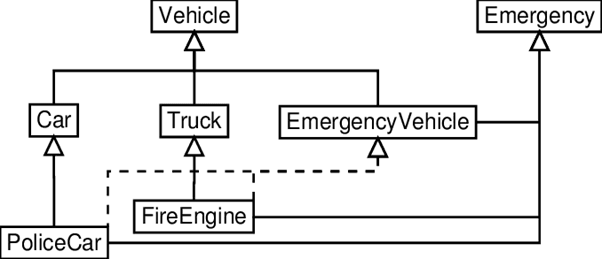
Inheritance allows a class (child/subclass) to acquire properties and behaviors of another class (parent/superclass). It promotes code reuse, hierarchical structuring, and extensibility. Java supports single inheritance via the extends keyword and multiple inheritance through interfaces.
Code:
class Vehicle {
    void start() {}
}

class Car extends Vehicle {
    void openDoor() {}
}
| Type | Description | Example |
|---|---|---|
| Single inheritance | One parent | Car extends Vehicle |
| Multilevel | Inherits from inherited class | SportsCar → Car → Vehicle |
| Interface-based | Multiple parents | Car implements Drivable, Insurable |
Technical Example:
An enterprise application models Users, AdminUsers, and SuperAdminUsers using inheritance for role-based access control.
Use Cases:
• Building domain models
• Creating role-based hierarchical structures
• Developing extensible application frameworks
Explanation:
Polymorphism enables methods to behave differently based on the object calling them. Java supports two types:
• Compile-time (method overloading)
• Runtime (method overriding)
Polymorphism makes code flexible, extensible, and easier to maintain, especially in dynamic enterprise applications where behavior changes based on context.
Code:
class Shape {
    void draw() { System.out.println("Drawing shape"); }
}

class Circle extends Shape {
    void draw() { System.out.println("Drawing circle"); }
}
| Type | Mechanism | Example |
|---|---|---|
| Overloading | Same name, different params | add(int), add(double) |
| Overriding | Same signature, subclass changes method | Circle.draw() |
Technical Example:
In a graphic editor, shapes (circle, rectangle, triangle) override the draw() method, enabling uniform yet specific rendering logic.
Use Cases:
• UI component rendering
• Strategy pattern implementations
• Framework extension points
Explanation:
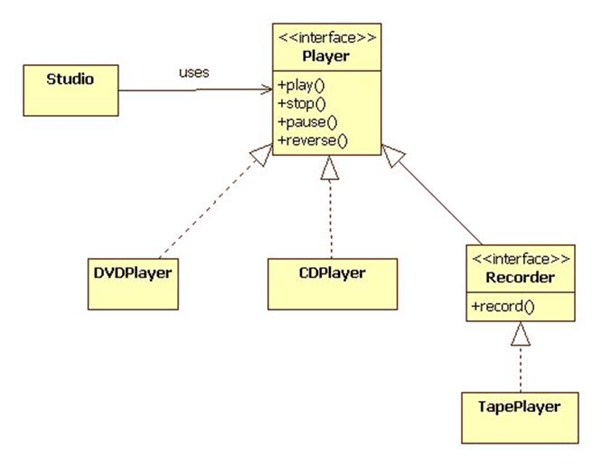
Abstraction hides complex implementation details and exposes only essential features. Java achieves abstraction through abstract classes and interfaces. Abstraction reduces coupling, isolates changes, and enhances system-level flexibility.
Code:
interface Payment {
    void process();
}

class CreditCardPayment implements Payment {
    public void process() { System.out.println("Processing credit card payment"); }
}
| Mechanism | Description | Use |
|---|---|---|
| Abstract class | Partial abstraction | Shared base functionality |
| Interface | Full abstraction | Contracts without implementation |
Technical Example:
A payment gateway supports multiple payment methods through the Payment interface.
Use Cases:
• Designing plugin architectures
• Ensuring loose coupling in microservices
• Building modular enterprise applications
Top Tutorials

CNN in Deep Learning 2026
A beginner-friendly guide to CNNs: understand deep learning essentials, create Python-based models, and explore advanced applications.

Breaking The Limits: Scaling Databases with MySQL Partitioning
Learn MySQL partitioning with examples. Improve query performance, scalability, and data management using RANGE, LIST, HASH, KEY, and composite techniques.

ML in Action: Hands-On Guide to Deploying and Serving Models
Learn model deployment and serving—from concepts to real-world architectures, tools, APIs, containers, and cloud workflows for production-ready ML.

 in Bengaluru, India


All Courses (6)
Master's Degree (2)
Fellowship (2)
Certifications (2)


 Platform Independence




 in Bengaluru, India