

Your Success, Our Mission!
6000+ Careers Transformed.
Explanation:
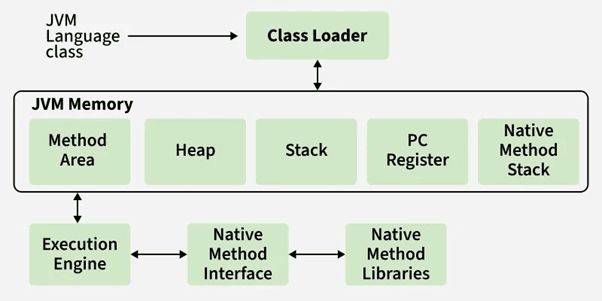
The Java Virtual Machine (JVM) is the core component that makes Java platform-independent. Unlike traditional compiled languages that translate source code into machine-specific binaries, Java compiles source code into bytecode, a platform-neutral intermediate representation. The JVM then interprets or compiles this bytecode into native instructions depending on the underlying operating system.
The JVM consists of several subsystems:
• Class Loader Subsystem – Loads class files dynamically into memory using loading, linking, and initialization phases.
• Runtime Data Areas – Memory model of the JVM, including heap, stack, method area, and program counter registers.
• Execution Engine – Interprets bytecode or compiles it to native code using the Just-In-Time (JIT) compiler.
• Native Interface (JNI) – Allows communication with native libraries (C or C++).
• Garbage Collector (GC) – Automatically manages memory by identifying and removing unused objects.
This layered architecture ensures that the same Java program runs identically on Windows, Linux, macOS, and embedded systems.
Code:
public class Hello {
    public static void main(String[] args) {
        System.out.println("JVM executes this bytecode uniformly.");
    }
}
| JVM Component | Purpose | Importance |
|---|---|---|
| Class Loader | Loads classes at runtime | Enables dynamic linking |
| Runtime Data Areas | Allocate memory | Ensures isolated execution |
| Execution Engine | Runs bytecode | Core processing unit |
| Garbage Collector | Cleans unused objects | Prevents memory leaks |
Technical Example:
A company deploying the same Java-based billing system on Linux servers and Windows desktops achieves identical behavior because JVM implementations for both platforms follow the same specification.
Use Cases:
• Cross-platform enterprise applications
• Cloud-native services deployed on heterogeneous servers
• Running Java applications on embedded devices
Explanation:
Bytecode is the heart of Java’s portability. When a Java program is compiled, the resulting .class files contain bytecode—not machine code. The JVM interprets or JIT-compiles this bytecode into platform-specific instructions. Because the bytecode format is universal, Java delivers consistent behavior and performance across devices.
Bytecode is also secure because it undergoes strict verification before execution. The verifier ensures there are no illegal memory accesses, stack overflows, or type mismatches. This mechanism significantly reduces runtime errors and enhances system safety.
Code:
// Compile-time generation of bytecode
javac Program.java

// JVM executes Program.class on any machine
java Program
| Stage | Action | Output |
|---|---|---|
| Compilation | javac converts .java to .class | Bytecode |
| Verification | JVM checks instructions | Safe to execute |
| Execution | Interpreter/JIT runs code | Platform-specific output |
Technical Example:
A Java application compiled on a Windows laptop can be copied to a Linux server and executed immediately because both systems have JVM implementations capable of interpreting the same bytecode.
Use Cases:
• Developing cloud-agnostic applications
• Mobile apps built for Android (Dalvik/ART bytecode)
• Writing Java libraries intended for global distribution
Top Tutorials

CNN in Deep Learning 2026
A beginner-friendly guide to CNNs: understand deep learning essentials, create Python-based models, and explore advanced applications.

Breaking The Limits: Scaling Databases with MySQL Partitioning
Learn MySQL partitioning with examples. Improve query performance, scalability, and data management using RANGE, LIST, HASH, KEY, and composite techniques.

ML in Action: Hands-On Guide to Deploying and Serving Models
Learn model deployment and serving—from concepts to real-world architectures, tools, APIs, containers, and cloud workflows for production-ready ML.

 in Bengaluru, India


All Courses (6)
Master's Degree (2)
Fellowship (2)
Certifications (2)


 Platform Independence



 in Bengaluru, India