

Your Success, Our Mission!
6000+ Careers Transformed.
Deploying a machine learning model may sound straightforward — train a model, wrap it in an API, and make it available for use. However, in reality, deployment comes with several challenges that must be addressed to ensure the model works reliably in production. Understanding these challenges is essential for creating robust, scalable, and maintainable ML solutions.
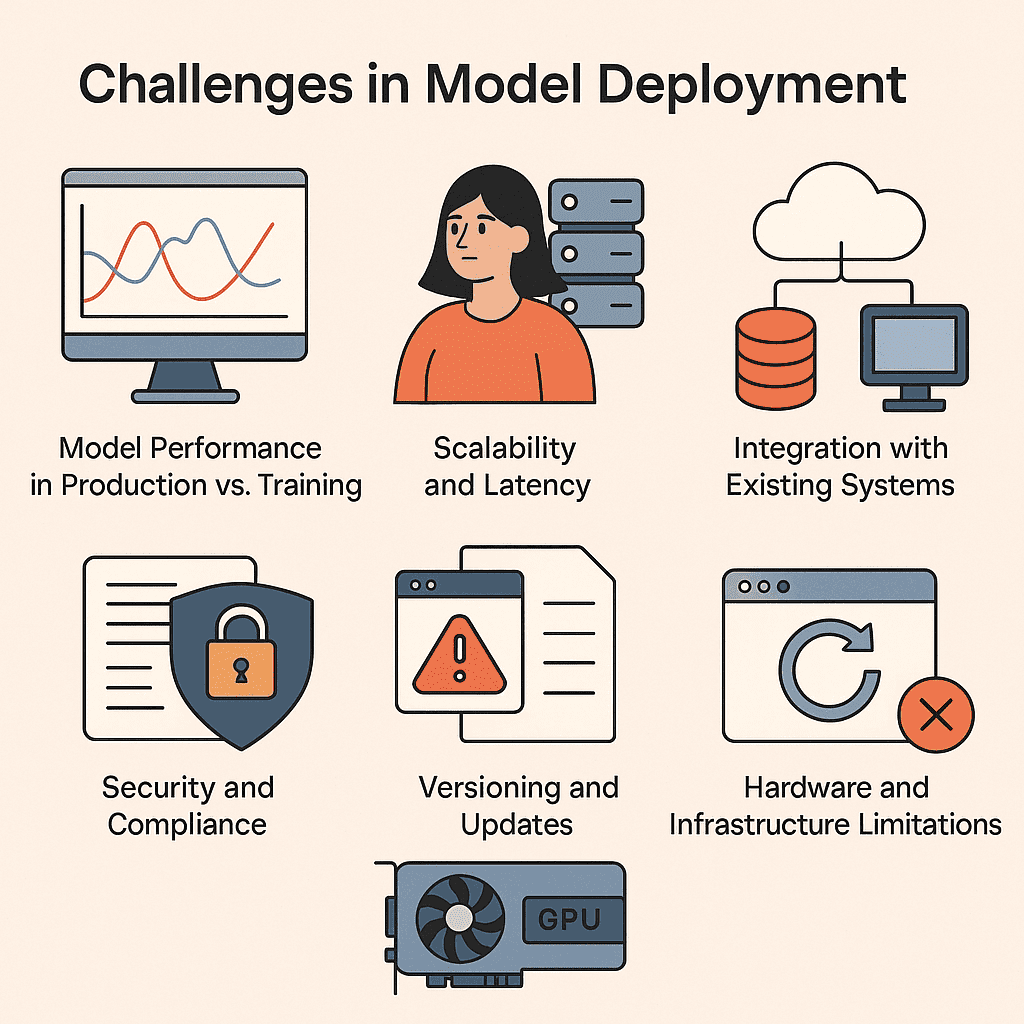
1. Model Performance in Production vs. Training
A model that performs exceptionally well on historical or test data may not always perform the same way in production. This is often due to:
Data drift: When the distribution of incoming data changes over time compared to the training data.
Concept drift: When the underlying relationships in the data evolve, making previous patterns less accurate.
For example, a model predicting customer churn trained on last year’s data may fail if user behavior changes significantly this year. Continuous monitoring and periodic retraining are essential to maintain accuracy.
2. Scalability and Latency
A deployed model must handle multiple simultaneous requests efficiently, often from thousands or millions of users. Common challenges include:
Ensuring low latency so predictions are returned quickly.
Designing the system to scale horizontally (adding more servers) or vertically (using more powerful machines).
Managing resource constraints, especially for computationally heavy models like deep learning networks.
If scalability is not considered, the system may become slow, fail under high load, or crash entirely.
3. Integration with Existing Systems
Models rarely operate in isolation. They must integrate seamlessly with existing applications, databases, or cloud services. Challenges include:
Designing APIs that are compatible with multiple client systems.
Ensuring secure and efficient data pipelines.
Handling edge cases, missing data, or unusual input formats gracefully.
Poor integration can render even the most accurate models unusable in practice.
4. Monitoring and Maintenance
Deployment is not a one-time activity. Models require continuous monitoring to ensure:
They provide accurate predictions over time.
Errors, downtime, or unexpected behavior are detected quickly.
Retraining or updates are applied when performance degrades.
Without monitoring, issues may go unnoticed, leading to incorrect predictions and potential business losses.
5. Security and Compliance
When models handle sensitive data — like medical records, financial transactions, or personal user information — security is paramount. Deployment challenges include:
Protecting APIs against unauthorized access or attacks.
Ensuring data privacy and compliance with regulations like GDPR or HIPAA.
Encrypting data in transit and at rest to prevent breaches.
Failing to address these concerns can result in serious legal, ethical, and financial consequences.
6. Versioning and Updates
Models evolve over time, and new versions may need to replace old ones without disrupting service. Challenges include:
Managing multiple model versions simultaneously.
Ensuring backward compatibility for applications relying on predictions.
Testing new versions thoroughly before deployment.
Proper versioning strategies help maintain system stability and minimize downtime during updates.
7. Hardware and Infrastructure Limitations
Some models, especially deep learning models, require high computational power, GPUs, or specialized hardware. Deployment challenges include:
Ensuring the infrastructure supports model requirements.
Optimizing model size and inference speed for constrained environments (e.g., mobile or edge devices).
Summary:
Deploying a machine learning model is far more than just exposing it via an API. Key challenges include:
Performance differences between training and production (data drift, concept drift).
Scalability and low-latency predictions.
Integration with existing systems and handling diverse data.
Continuous monitoring, maintenance, and retraining.
Security, compliance, and data privacy concerns.
Versioning and smooth updates.
Infrastructure and hardware limitations.
Addressing these challenges is critical to ensure that your model not only works but also provides reliable, scalable, and secure predictions in the real world.
Top Tutorials

GATE 2026 Data Science and AI
Explore this free tutorial to understand various concepts of GATE Data Science and AI 2026 . Learn probability, algebra, calculus, etc.

ChatGPT
In this ChatGPT tutorial, learn how to use ChatGPT effectively. Master the art of conversational AI with our step-by-step lessons. Start to learn ChatGPT today!

Artificial Intelligence
Dive into our comprehensive Artificial Intelligence tutorial and master the fundamentals of AI. From an introduction to advanced concepts, learn AI from scratch

 in Bengaluru, India



All Courses (6)
Master's Degree (2)
Fellowship (2)
Certifications (2)

 What is Model Deployment?


 in Bengaluru, India