

Your Success, Our Mission!
6000+ Careers Transformed.
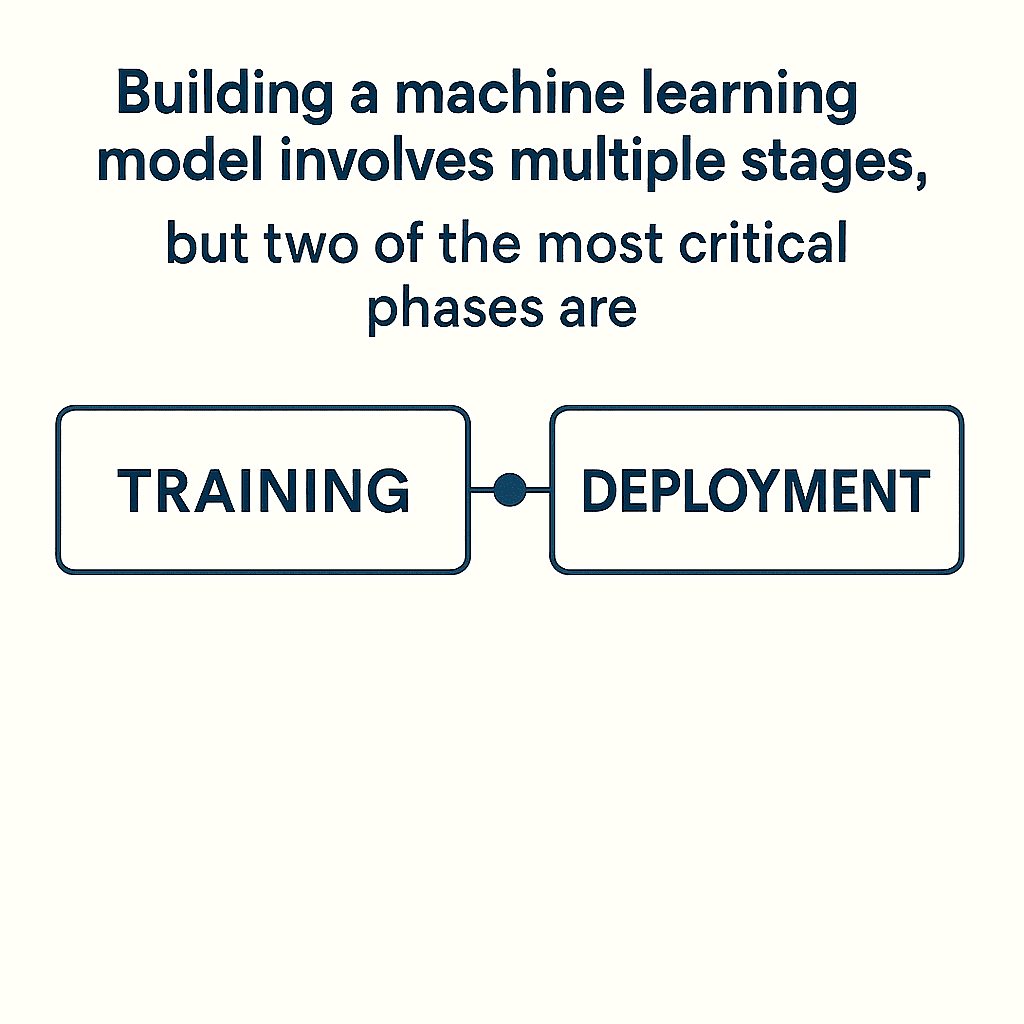
Building a machine learning model involves multiple stages, but two of the most critical phases are training and deployment. While they are closely connected, they serve very different purposes in the ML lifecycle. Understanding the difference is essential to bridge the gap between model development and real-world usage.
Model Training:
Model training is the process of teaching the machine learning algorithm to learn patterns from historical data. During this phase, you:
Collect and clean data.
Split the data into training and testing sets.
Train a model by feeding it data and optimizing its parameters.
Evaluate performance using metrics such as accuracy, precision, recall, or RMSE.
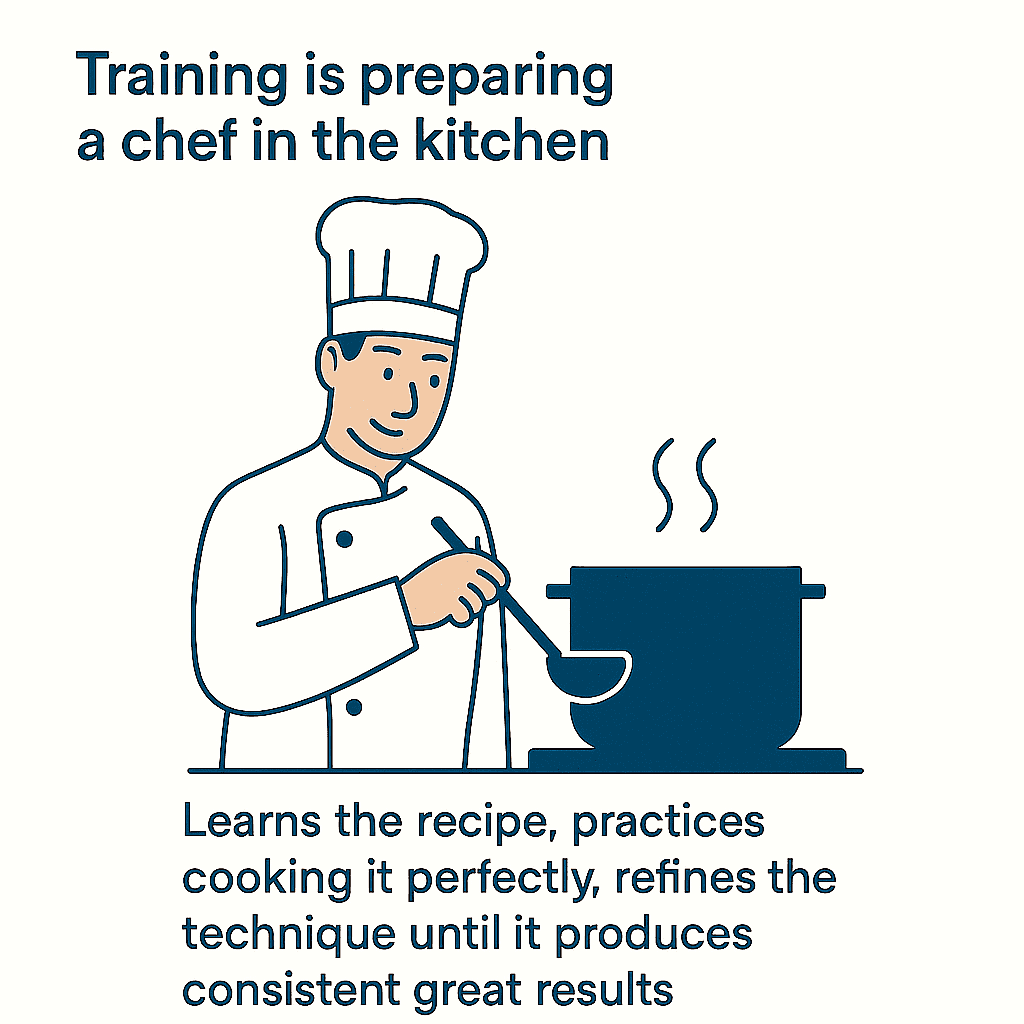
Think of training as preparing a chef in the kitchen. The chef learns the recipe, practices cooking it perfectly, and refines the technique until it consistently produces great results.
Key characteristics of training:
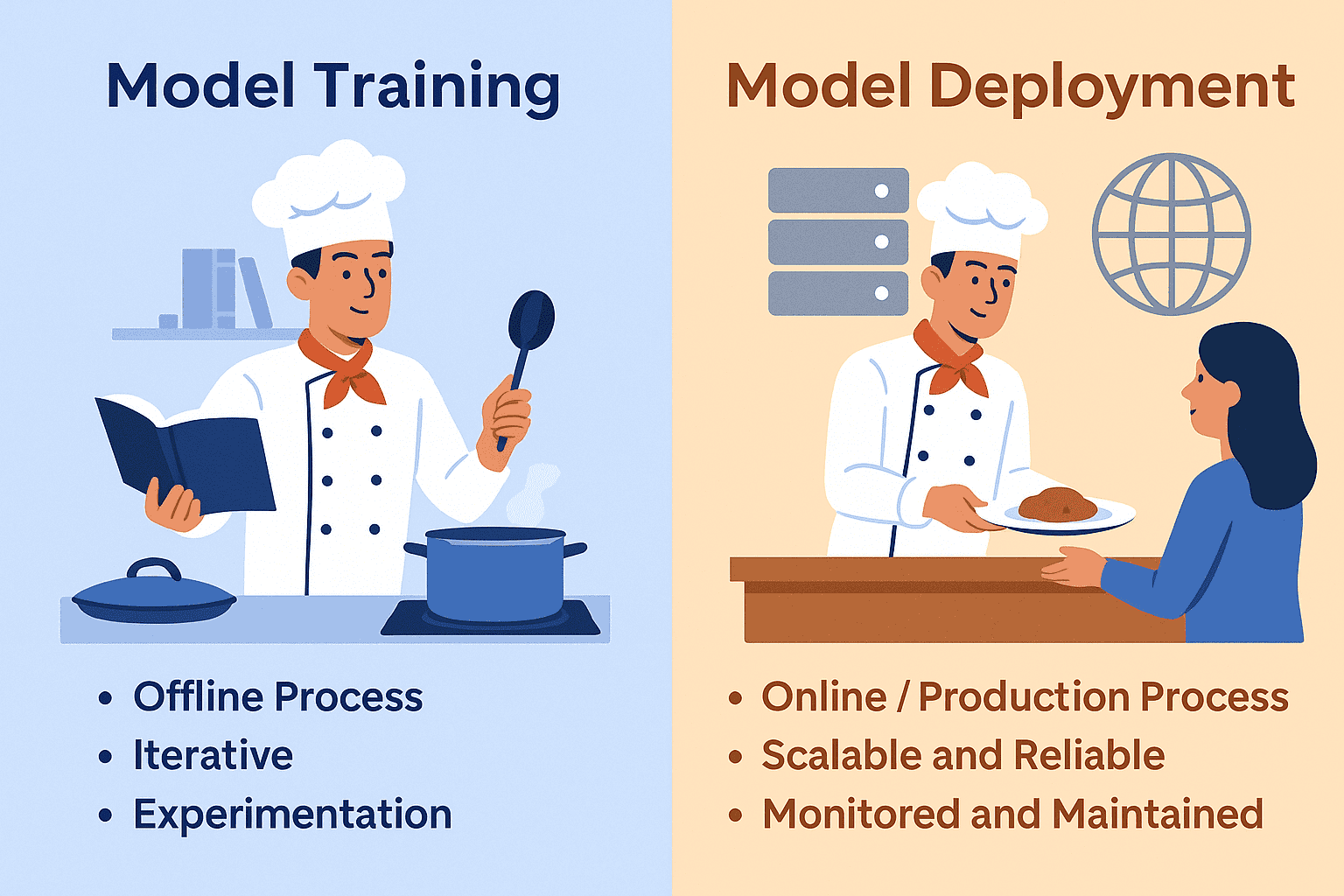
Offline Process: Training happens on historical data, usually on your local machine or a dedicated training server.
Iterative: You may need multiple iterations, tuning hyperparameters, testing different algorithms, or adding more data.
Experimentation: Training is a learning and testing phase; the model may not be ready for production yet.
Model Deployment:
Deployment is the next step after training. It’s about taking the trained model and making it available for real-world use. In this phase, you:
Serialize the model (save it in a reusable format).
Wrap it in a service or API so it can accept input and return predictions.
Host it on a server, cloud platform, or edge device for real-time or batch usage.
Monitor performance, handle errors, and ensure it scales with demand.
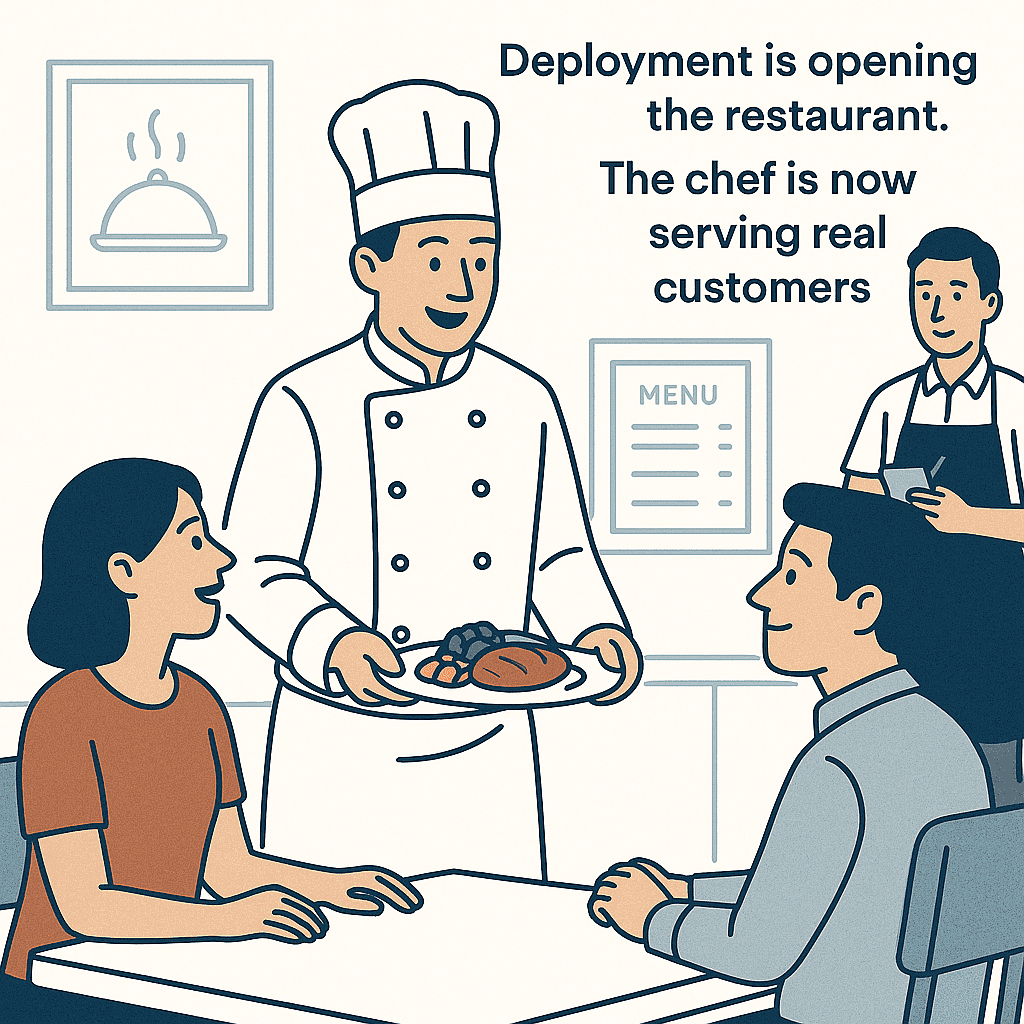
Continuing the chef analogy, deployment is opening the restaurant. The chef is now serving real customers, taking orders, and delivering dishes consistently. Customers experience the recipe in real life, and the chef’s skills create real impact.
Key characteristics of deployment:
Online / Production Process: Deployment makes the model accessible to applications, users, or systems.
Scalable and Reliable: Handles multiple requests simultaneously without errors.
Monitored and Maintained: Ensures the model continues to perform well over time.
Major Differences Between Training and Deployment:
Aspect | Training | Deployment |
| Purpose | Learn patterns from data | Serve predictions in real-world scenarios |
| Environment | Local machines, notebooks, or training servers | Production server, cloud, or edge devices |
| Nature | Offline, experimental | Online, operational |
| Users | Data scientists / ML engineers | End-users, applications, systems |
| Focus | Accuracy, optimization, experimentation | Reliability, scalability, accessibility |
Why Understanding the Difference Matters:
Many beginners assume that building a good model is enough. But a highly accurate model that is never deployed is essentially useless in practice. Deployment ensures that the model’s predictions reach the people, systems, or processes that need them, creating real-world value.
In real scenarios:
A trained fraud detection model that is never deployed cannot prevent financial loss.
A recommendation system that stays in a notebook cannot suggest products to users in real time.
Properly separating training and deployment phases also allows versioning, testing, and maintenance without disrupting live systems.
Summary:
Training and deployment are two distinct but complementary stages of the ML lifecycle.
Training focuses on learning from historical data, experimentation, and achieving high accuracy.
Deployment focuses on serving predictions reliably, efficiently, and at scale to end-users or systems.
Understanding this difference is crucial for building ML solutions that not only work well but also create real-world impact.
Top Tutorials

GATE 2026 Data Science and AI
Explore this free tutorial to understand various concepts of GATE Data Science and AI 2026 . Learn probability, algebra, calculus, etc.

ChatGPT
In this ChatGPT tutorial, learn how to use ChatGPT effectively. Master the art of conversational AI with our step-by-step lessons. Start to learn ChatGPT today!

Artificial Intelligence
Dive into our comprehensive Artificial Intelligence tutorial and master the fundamentals of AI. From an introduction to advanced concepts, learn AI from scratch

 in Bengaluru, India



All Courses (6)
Master's Degree (2)
Fellowship (2)
Certifications (2)

 What is Model Deployment?


 in Bengaluru, India