

Your Success, Our Mission!
6000+ Careers Transformed.
Serving strategies can be broadly categorized as synchronous or asynchronous, depending on how predictions are requested and delivered.
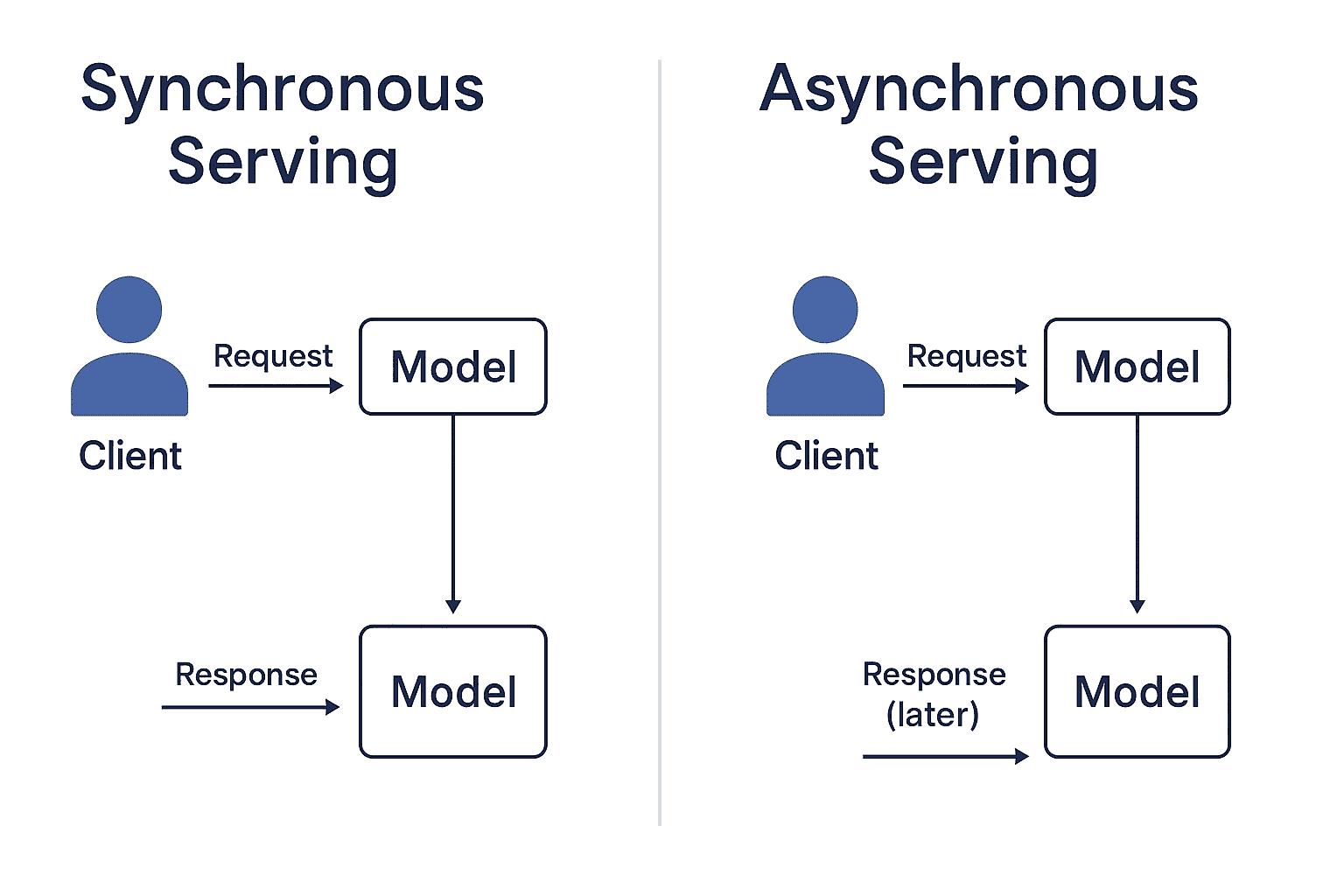
1. Synchronous Serving:
The client sends a request and waits for the model to return a response immediately.
Suitable for real-time applications where low latency is critical.
Example: An online chatbot generating responses instantly.
Advantages:
Simple to implement.
Immediate feedback for end-users.
Challenges:
High traffic can overload the system if not scaled properly.
Each request blocks resources until the response is returned.
2. Asynchronous Serving:
The client sends a request, and the model processes it in the background, returning results later.
Suitable for batch processing or tasks where immediate results aren’t required.
Example: Generating daily sales forecasts or processing large datasets offline.
Advantages:
Can handle large workloads efficiently.
Reduces system blocking and allows queuing of requests.
Challenges:
Slightly more complex to implement.
Users do not get immediate results.
Top Tutorials

GATE 2026 Data Science and AI
Explore this free tutorial to understand various concepts of GATE Data Science and AI 2026 . Learn probability, algebra, calculus, etc.

ChatGPT
In this ChatGPT tutorial, learn how to use ChatGPT effectively. Master the art of conversational AI with our step-by-step lessons. Start to learn ChatGPT today!

Artificial Intelligence
Dive into our comprehensive Artificial Intelligence tutorial and master the fundamentals of AI. From an introduction to advanced concepts, learn AI from scratch

 in Bengaluru, India



All Courses (6)
Master's Degree (2)
Fellowship (2)
Certifications (2)

 What is Model Deployment?


 in Bengaluru, India