






Breaking into tech with zero experience can feel impossible but becoming an AI engineer is more achievable than ever. As AI adoption explodes across every industry, the demand for skilled AI professionals is sky-high in 2025 and only growing. Companies aren’t just looking for experts anymore; they’re actively hiring motivated beginners who can learn fast, build projects, and understand real-world applications of AI.
This guide is designed as the ultimate AI engineer roadmap for beginner readers, showing you exactly what skills to learn, what tools to use, and how to build a portfolio even if you’re starting from scratch. Whether you’re a student, career switcher, or tech enthusiast, this beginner's roadmap will give you a clear, confident path to becoming a successful AI engineer in today’s rapidly evolving tech world.
What is an AI Engineer and What Do They Really Do?
An AI Engineer is a technology professional who designs, builds, trains, and deploys artificial intelligence systems that help machines learn, think, and make smart decisions. Unlike traditional developers who only focus on writing code, an AI Engineer works deeply with data, machine learning models, and intelligent algorithms to create systems that can analyze information, recognize patterns, and automate complex tasks.
A key responsibility of an AI Engineer is building AI models, choosing the right algorithms, and designing how the system will learn. They also handle training and tuning datasets, working with large amounts of data to make sure AI systems are accurate, reliable, and unbiased. AI Engineers frequently work with neural networks and large language models (LLMs), which power technologies like chatbots, image recognition, recommendation systems, and advanced automation tools.
Their job doesn’t end at development. An AI Engineer is also responsible for deploying AI solutions into real-world applications, ensuring performance, security, and scalability.
Common job titles include:
- AI Engineer
- Machine Learning Engineer
- NLP Engineer
- Computer Vision Engineer
AI Engineers work across many industries, including tech companies, healthcare, finance, and SaaS, helping build smarter products and solutions. In simple terms, an AI Engineer is the creator behind intelligent systems shaping the future of technology, making this role one of the most in-demand and impactful careers today.
Do You Need a Degree to Become an AI Engineer?
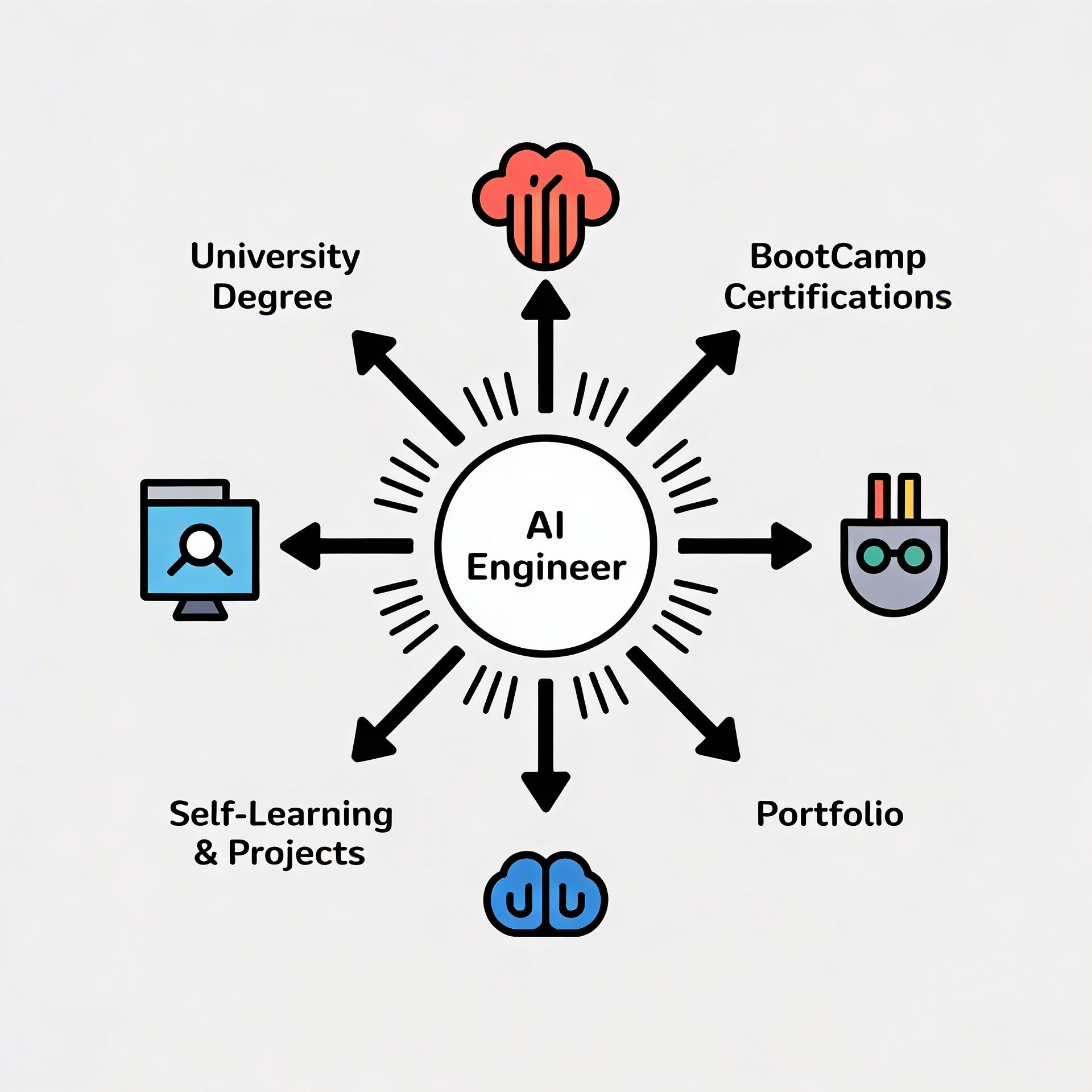
One of the biggest questions beginners ask is: “Do you need a degree to become an AI Engineer?” The honest answer is no, a degree is helpful but not mandatory. While many AI Engineers come from computer science or engineering backgrounds, the industry has shifted massively toward skill-based hiring, especially in 2025 and beyond. Companies care more about what you can build, how well you understand AI concepts, and whether you can solve real problems than whether you have a traditional university qualification.
If you want to become an AI engineer without degree qualifications, there are multiple alternative learning paths. Many people break into AI through bootcamps, which provide structured, hands-on learning in a shorter time. Others choose certifications, which prove technical skills to employers and help you stand out. Self-learners can also succeed using online courses, tutorials, open-source projects, and consistent practice. Real-world projects, GitHub portfolios, and problem-solving abilities often matter more than formal education.
In today’s hiring landscape, experience with AI tools, machine learning frameworks, data handling, and deployment skills speaks louder than a diploma. Employers want proof of capability, adaptability, and passion.
So, can beginners become AI engineers? Absolutely. With the right learning path, practical projects, and persistence, anyone can build a successful career in AI. You can follow this AI engineer roadmap for beginners without a degree, gain relevant skills, and confidently step into one of the most in-demand careers in tech.
Essential Skills Required to Become an AI Engineer
If you’re serious about becoming an AI professional, understanding the skills needed for AI Engineer success is crucial. These aren’t just technical abilities; they’re the foundation that helps you build real, practical AI solutions. Here are the most important AI Engineer beginner skills to focus on.
Programming Skills for AI Engineers
Programming is at the core of AI development. Python is the most important language because it’s beginner-friendly and supports powerful AI libraries. However, optional languages like R, C++, and JavaScript can also be useful depending on your goals and industry. Strong coding skills help you write efficient models, automate workflows, and work seamlessly with data.
Math Foundations
You don’t need to be a math genius, but you do need solid basics. Key areas include statistics, which helps interpret data, probability, which supports predictions, and linear algebra concepts, which play a big role in neural networks and machine learning algorithms.
Machine Learning & Deep Learning Basics
Understanding supervised and unsupervised learning, neural networks, and deep learning fundamentals is essential. These concepts help you understand how AI learns, adapts, and improves over time.
AI Tools & Frameworks
Modern AI relies heavily on tools. Popular frameworks like TensorFlow, PyTorch, Scikit-learn, Hugging Face, and OpenAI tools help you build and experiment with AI models efficiently.
Cloud & Deployment Knowledge
Finally, knowing the basics of AWS, GCP, or Azure, along with an introduction to MLOps, helps you deploy AI systems into real-world environments so your models aren’t just theoretical, they’re practical and usable.
Mastering these skills puts you on the right path toward becoming a confident and capable AI Engineer.
Best Courses and Certifications to Become an AI Engineer
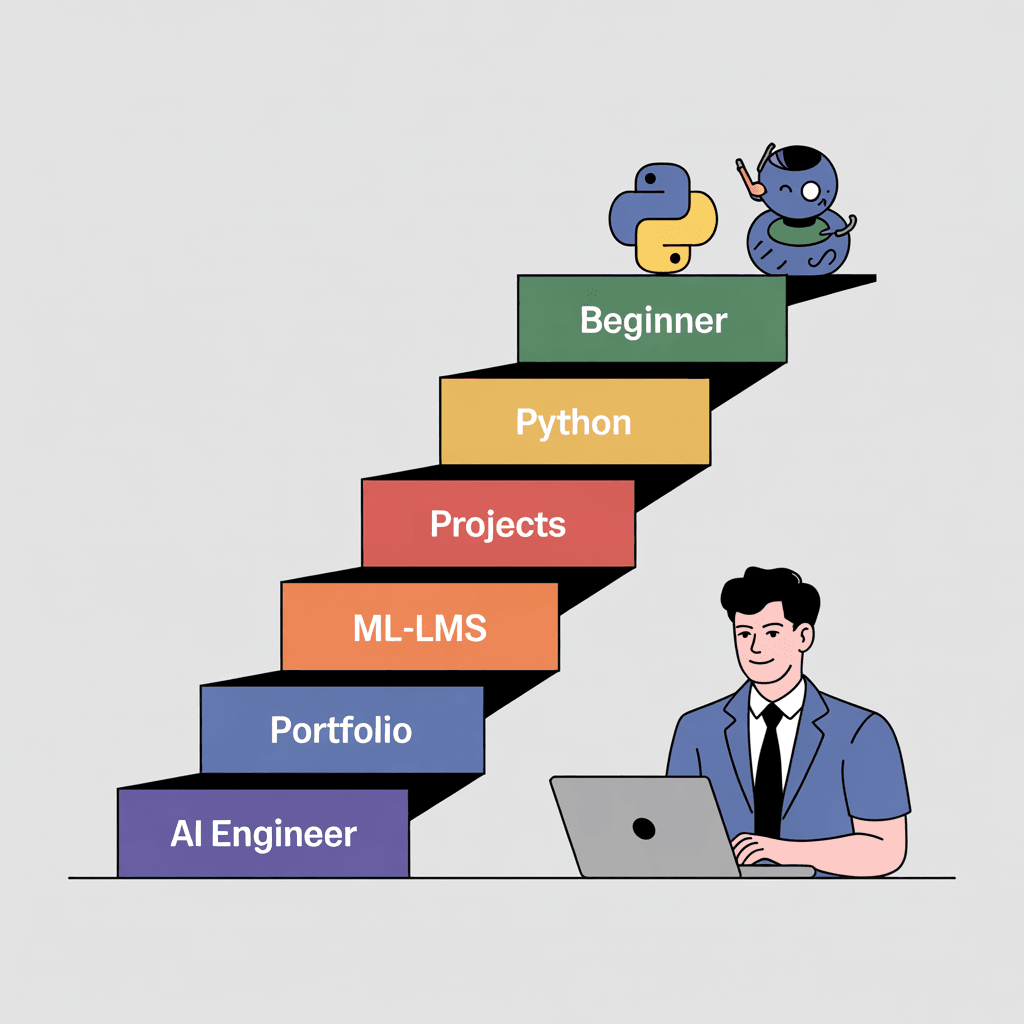
Choosing the right learning program is one of the biggest decisions for beginners, and this is where platforms like AlmaBetter make a real difference. If you’re looking for the best AI course for beginners, AlmaBetter offers structured, industry-oriented learning paths that focus on practical skills, real-world projects, and job readiness rather than just theory. Their programs are perfect for an AI engineer beginner learning path, especially if you’re starting with little or no prior experience.
Beginner-Friendly AI Learning Paths
AlmaBetter provides beginner-friendly AI programs that first build strong foundations in Python, data handling, and core AI concepts. The learning journey is structured so you progress step by step with guided mentorship and hands-on exercises ideal for absolute beginners.
Machine Learning & Deep Learning Programs
Once the basics are clear, AlmaBetter’s machine learning and deep learning programs help learners dive deeper into supervised learning, neural networks, and advanced deep learning concepts through practical projects and industry case studies. This ensures you’re not just learning, but actually building.
Cloud AI Certifications
Since modern AI heavily depends on deployment, AlmaBetter also includes exposure to cloud platforms like AWS, Azure, and GCP, helping you understand how AI systems work in real production environments.
Affordable Options + Free Resources
One of the best parts about AlmaBetter is accessibility. Their learning structure, EMI options, and beginner support make high-quality AI education more affordable. Learners also get access to practice resources, community support, and guided career assistance.
Which Should Beginners Choose?
If you’re starting your journey, AlmaBetter’s structured curriculum is one of the strongest AI engineer beginner learning path options. Begin with their beginner track, move into ML and deep learning, then explore cloud skills, ensuring you grow confidently into a job-ready AI Engineer.
How Beginners Can Get AI Experience With No Background
Want AI engineer experience without prior expertise? Here are real, practical AI beginner opportunities:
- Start With Simple Portfolio Projects
- Build beginner-friendly AI projects like spam detector, movie recommendation system, chatbot, or image classifier.
- Host on GitHub + create case study writeups.
- Contribute to Open-Source AI
- Join beginner-friendly repos on GitHub.
- Fix documentation, run tests, improve small features—every contribution counts.
- Great places: Hugging Face, TensorFlow, Scikit-Learn projects.
- Participate in Kaggle Competitions
- Start with “Getting Started” competitions.
- Learn real datasets, model building, evaluation, and teamwork.
- Helps showcase hands-on AI engineer experience.
- Join AI Hackathons
- Short, intense learning + networking.
- Work with teams, build end-to-end AI applications.
- Many beginner-friendly hackathons online.
- Volunteer for AI Projects
- Offer help to NGOs, startups, student clubs.
- Build chatbots, automation tools, or analytics dashboards.
- Real-world experience = strong resume.
- Network on LinkedIn
- Share projects, write learning posts, connect with AI mentors.
- Engage in AI communities and job-ready conversations.
- Many AI beginner opportunities come from networking.
- Learn Continuously
- Follow structured AI roadmaps.
- Practice consistently rather than consuming theory.
Even with no technical background, consistency and hands-on projects can turn you into a job-ready AI Engineer.
AI Engineer Salary & Career Growth in 2026
The AI engineer salary continues to rise rapidly in 2026 as companies invest heavily in automation, AI-driven products, and intelligent systems.
Entry-level AI Engineers can expect competitive starting packages, typically ranging from strong base pay to additional bonuses depending on skills in Python, ML, cloud, and real-world project experience.
At the mid-level, AI engineers see a significant jump in earnings as they manage larger models, optimize systems, and contribute to production-ready AI solutions. With 3–6 years of experience, professionals often transition into roles like Machine Learning Engineer, NLP Engineer, or Computer Vision Specialist with much higher compensation.
For senior AI engineers, salaries peak with leadership roles such as AI Architect, Lead ML Engineer, and Head of AI. These roles come with premium pay due to expertise in designing scalable AI ecosystems, leading teams, and driving AI strategy.
Career progression in AI engineering is fast, future-proof, and highly rewarding, making it one of the most lucrative tech careers in 2026 and beyond.
Common Mistakes Beginners Make (And How to Avoid Them)
Many beginners rush into AI and make avoidable mistakes. One of the biggest is learning too many things without depth. Instead, focus on strong foundations like Python, math, and core ML concepts before jumping to advanced tools. Another mistake is ignoring math completely. While you don’t need to be a mathematician, basic statistics, probability, and linear algebra are essential to understand how AI models work.
A lot of learners also avoid building projects, which limits practical understanding. Start small, then gradually work on real-world AI applications. Similarly, having no portfolio hurts opportunities to maintain a GitHub, Kaggle, or personal website to showcase work. Finally, many beginners don’t network, missing out on jobs, mentorship, and collaborations. Stay active on LinkedIn, connect with AI professionals, and participate in communities to grow faster and smarter.
Final Thoughts: Can Beginners Really Become AI Engineers in 2026?
If you’re wondering whether a beginner can truly become an AI Engineer in 2026, the answer is a confident yes. With the right learning plan, dedication, and a structured approach, anyone can transition into AI, even without prior experience. Start with Python, math basics, and beginner AI concepts, then move into machine learning, deep learning, modern AI tools, and hands-on real-world projects that showcase your capability.
Build a strong GitHub portfolio, stay active on LinkedIn, work with LLMs, APIs, and cloud platforms, and gradually apply for internships, freelance work, and entry-level AI roles. With consistent effort, the roadmap to becoming an AI Engineer becomes achievable.
If you’re serious about turning this dream into a career, platforms like AlmaBetter can help you with structured learning, mentorship, real projects, and job support making your AI journey smoother and faster.
Start learning today, stay consistent, and let your AI journey begin!





 in Bengaluru, India


 in Bengaluru, India